
Partner With Us - Current Themes
Recommended for:
- All sorts of companies that make use of ultrasonic sensors, such as the automotive industry and makers of sensor-related devices
- Companies that develop equipment for the biomedical and health-care areas, such as equipment for medical imaging and diagnosis
- Companies that develop equipment for non-destructive testing, industrial inspection, etc.
What is Murata's Ultrasound Transmission Metamaterial?
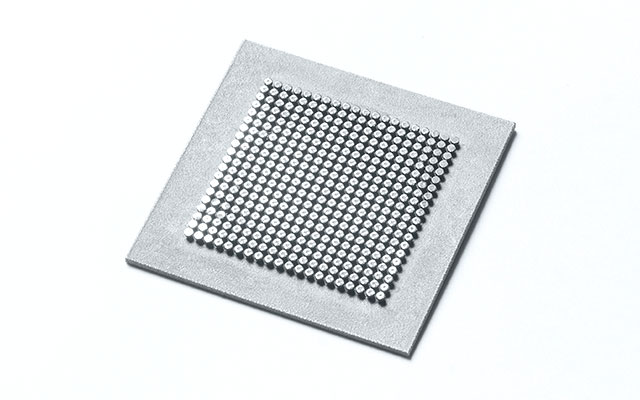
In general, acoustic metamaterials refer to artificial materials that are designed to manipulate
sound waves in ways that traditional acoustic materials cannot.
They are used to absorb or reflect sound in noise-damping applications. By contrast, ultrasound
transmission metamaterial of Murata was developed with the aim of “increasing the transmittance of
ultrasonic waves through materials” by using a resonating mechanism that incorporates a mass-spring
resonator structure.
For example, if there is some kind of material (Obstacle) in front of ultrasonic sensors, most of the
ultrasound waves will be reflected instead of being transmitted through the material due to the
difference in acoustic impedances, but by using metamaterial technology of Murata, the ultrasound
waves can be transmitted through the material and can be conveyed to the target.
Features of Murata's Ultrasound Transmission Metamaterial
How does Murata's ultrasound transmission metamaterial work? Here we explain the mechanism and technology involved.
Addressing the problem of impedance mismatch of mediums to transmit the ultrasound.
Ordinarily, when ultrasonic waves encounter a substance that differs from the medium and has a different acoustic impedance, they are reflected rather than passing through.
For example, when you undergo an ultrasound scan of your abdomen, the technician will first apply a gel to your skin. This is done to eliminate the difference in acoustic impedance. Murata’s acoustic metamaterials, in contrast, are able to increase the transmission rate of ultrasonic waves even with substances having different acoustic impedances. This may someday enable more improved ultrasound scans.
*Click here for more information on "acoustic impedance"
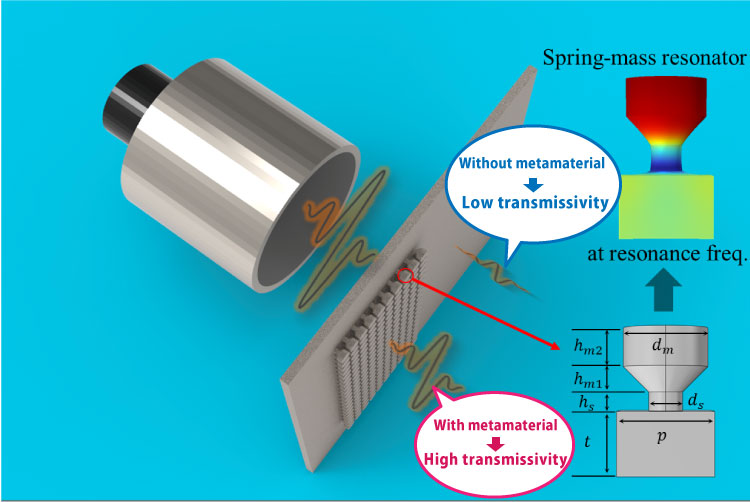
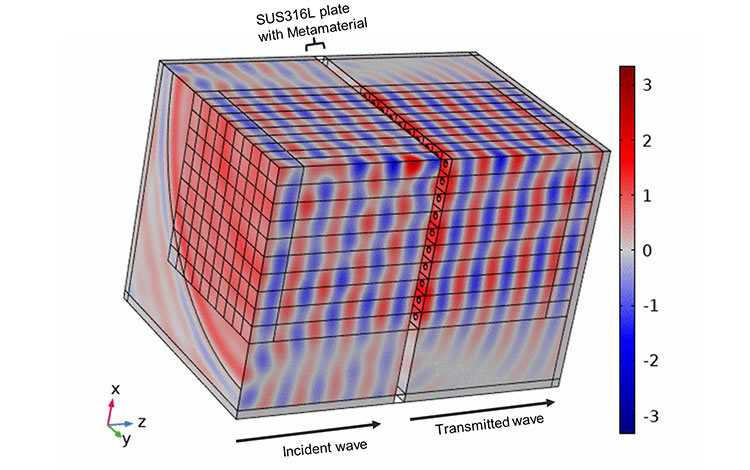
The ultrasound transmission metamaterial addresses the issue of impedance mismatch and
enhances the transmission of ultrasound through materials.
The key technological aspect lies in utilizing the resonance mechanism of a mass-spring-based structure.
The key technical point that enables the ultrasound transmission metamaterial to assist ultrasonic waves in passing through substances is the use of a resonating mechanism of "mass and spring" based structures.
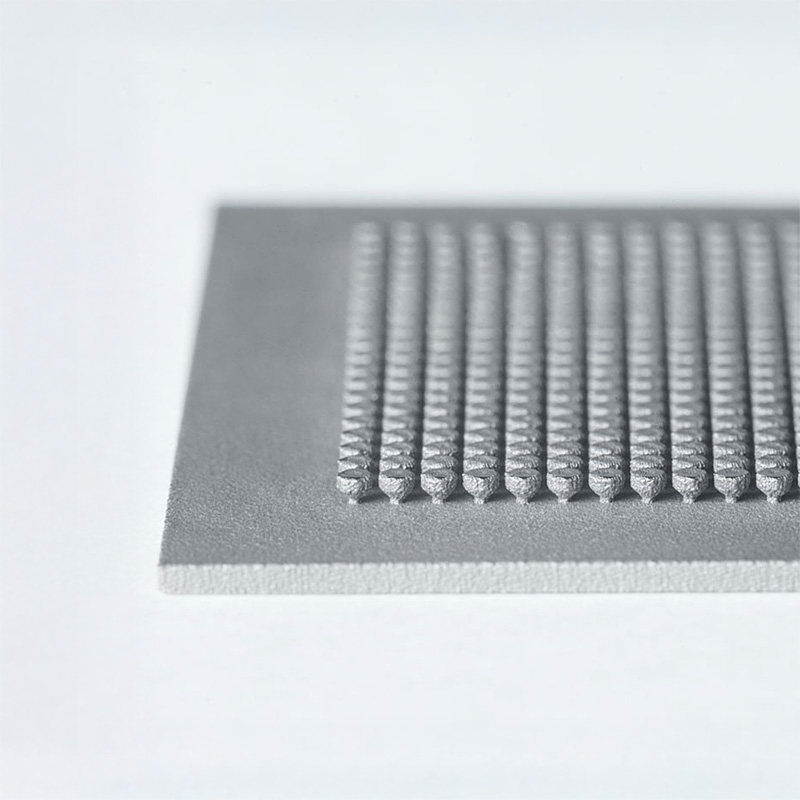
Ultrasmall unit cells arranged periodically and each consisting of a mass and spring, are designed to oscillate at the resonance frequency of the incident ultrasonic waves. This allows ultrasonic waves to be transmitted efficiently even when passing through a substance such as metal with a different acoustic impedance.
By designing unit cells compatible with the difference in acoustic impedance between the substance and the medium, Murata Manufacturing has made it possible for ultrasonic waves to be transmitted through many different types of substances.
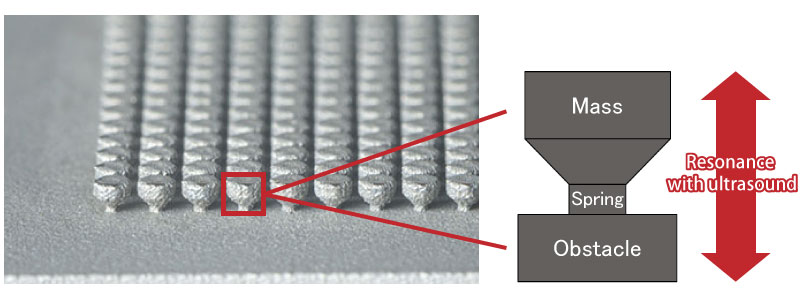
The metamaterial structures resonate at the specifically designed frequency of ultrasound, functioning as a secondary acoustic source to augment ultrasound transmission.
Features of Murata Manufacturing’s Ultrasound Transmission Metamaterial
Murata’s exclusive metamaterial has the following three features.
- Amazing acoustic properties (high ultrasound transmittance)
- Ability to transmit the ultrasound from both sides of the acoustic metamaterial (patent pending in U.S.)
- Applicable to large acoustic impedance differences
Application areas of Ultrasound Transmission Metamaterial
Utilizing the property of ultrasound transmission metamaterial technology to improve the transmission of ultrasound through materials, the range of applications is broad, including the biomedical and healthcare fields and the marine field.
Biomedical and health-care areas
Ultrasonic waves have many applications in the medical field, including ultrasonic imaging and diagnosis and the use of ultrasonic waves in treatment. Combining medical equipment and ultrasound transmission metamaterial holds the potential to enable development of new testing methods that are less burdensome to patients.
Marine applications
For example, ultrasound transmission metamaterial could make possible nondestructive inspection of underwater cables, etc., from above the protective covering. They have the potential to reduce the workload associated with inspection of underwater objects in seas and rivers.
Automotive applications
By using ultrasound transmission metamaterial, ultrasonic sensors can be placed behind the bumper, and a harmonious blend of vehicle aesthetics and safety measures can be achieved simultaneously.
FAQ
Periodically arranged mass-spring resonators are designed to resonate at specific ultrasonic frequencies. They receive incident ultrasonic waves as mechanical vibrations and then re-remit them in the opposite direction. This enables ultrasound transmission even between materials with different acoustic impedances.
The size of the unit cell depends on the target ultrasonic frequency. Therefore, it is possible to adjust the design and shape of the metamaterial to suit specific frequencies.
The applicable frequencies range from the kHz band to the MHz band. In principle, even the GHz band can be supported. However, the wavelengths become extremely short, so processing and manufacturing becomes more difficult.
The principle is based on the vibration of a unit cell. Therefore, it is basically possible to apply it to various substances as long as they are hard materials that do not significantly attenuate the vibrations.
Inquiries about Ultrasound Transmission Metamaterial
Please feel free to Contact Us if you are interested in the new ultrasound transmission metamaterial that enhances ultrasound transmittance thanks to our unique technology, or if you want to learn more about this technology.
*This product is under development. Therefore, the specifications are subject to change without prior notice.
Message from the developers

Murata Manufacturing Co., Ltd.
Material Process Development Dept. Material Technology Center Technology & Business Development Unit
-
Mudassir Hussain
Masaya Nishida -
We invite you to join us in expanding the horizons of ultrasonic technology.
Murata's revolutionary ultrasound transmission metamaterial technology has the unique capability to enable ultrasonic waves to pass through obstacles placed in a variety of mediums. This breakthrough opens up a multitude of possibilities across various industries, including medical imaging, automobiles, underwater acoustics, etc.
At Murata, we firmly believe in the power of collaboration and co-creation. We eagerly welcome partners from all industries utilizing ultrasonic sensors to embark on this exciting journey with us. Together, let's explore innovative applications and extend the boundaries of what can be achieved with ultrasonic technology.
Notices
-
We have published a technical article titled “What Are Materials That Expand Possibilities with Behavior Not Found in Substances in the Natural World?”
-
We have published a technical article titled “‘Ultrasound Transmission Metamaterial’ that Expands the Range of Places where Ultrasonic Sensors Can Be Used to Include Medicine and Automobiles.”
-
We have posted the ultrasound transmission metamaterial development theme for which we are looking for collaboration partners.
Read More


Inquiries
Please feel free to Contact Us if you are interested in the new ultrasound transmission metamaterial that enhances ultrasound transmittance thanks to our unique technology, or if you want to learn more about this technology.
*This product is under development. Therefore, the specifications are subject to change without prior notice.