

Partner With Us - Current Themes
Metamaterial technology that enhances
ultrasound transmission in liquid and gaseous media
Ultrasound Transmission Metamaterial
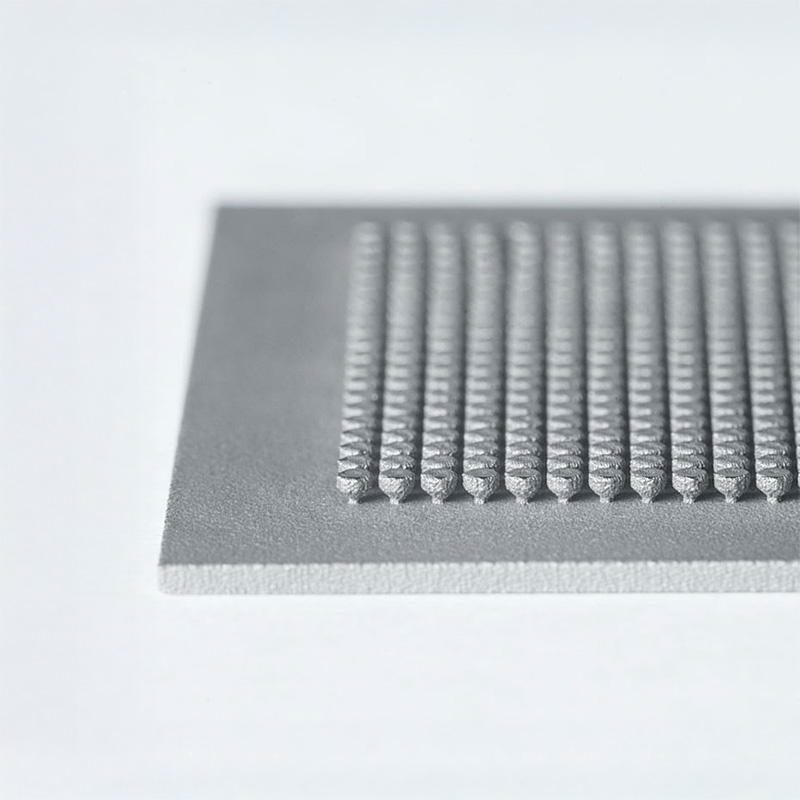
Recommended for:
- Those facing challenges with ultrasonic transmission through materials such as metals and plastics.
- Those considering ultrasonic sensing for applications such as in-vehicle sensing and the measurement of flow, level, or remaining volume.
- Those facing challenges in ultrasonic measurement or detection due to the transmission medium or installation constraints.
Ultrasound Transmission Metamaterial
Generally known as “acoustic metamaterials,” these are engineered materials that control sound waves in ways conventional acoustic materials cannot. These metamaterials are used to absorb or reflect sound in applications such as noise reduction.
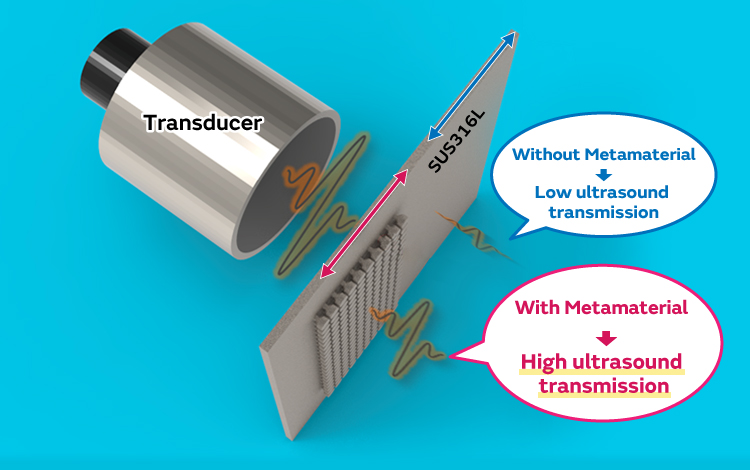
In contrast, the ultrasound transmission metamaterial technology being developed by Murata enhance the transmission of ultrasound through metal, plastic, and other materials.
Normally, these materials would impede measurement or detection if they are in front of ultrasonic sensors because a large portion of the waves is reflected at the interface due to differences in the acoustic impedance* between the material and the medium.
Murata's technology can enhance ultrasound transmission through these materials.
Recent advances have enabled substantial improvements in ultrasound transmission through metal and other materials, not only with liquid media, but also with gaseous media where the acoustic impedance differs greatly from that of the material.
This technology expands the possibilities in measurement and detection that have been difficult due to the constraints of the installation environment or target objects.
*Acoustic impedance: An indicator of how easily sound waves travel through various materials or media. Substances that are quite different from each other in terms of acoustic impedance are more likely to cause the reflection of ultrasonic waves at the interface between them.
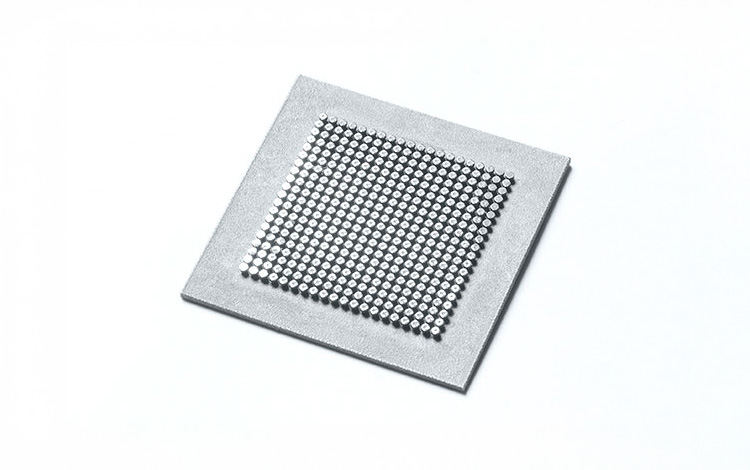
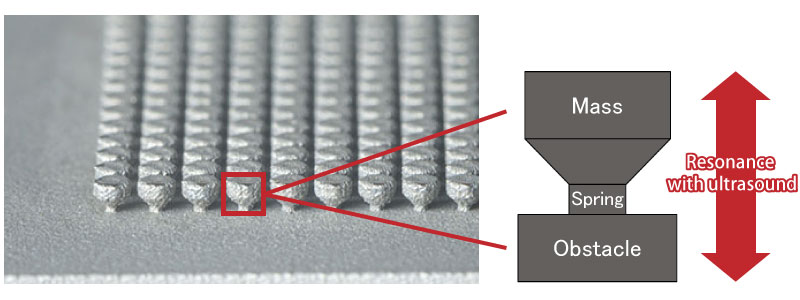
with an array of unit cells
How Ultrasound Transmission Is Enhanced
Murata's ultrasound transmission metamaterial consists of a periodic array of miniature resonators known as unit cells.
Each unit cell has a resonant structure similar to a mass-spring system and vibrates in response to incident ultrasonic waves.
By utilizing the resonance of these unit cells, the metamaterial efficiently induces vibrations in the target material. This enables ultrasonic waves that would normally be reflected at the material interface to propagate more effectively through the material, resulting in improved ultrasound transmission efficiency.
The structure of the unit cells is designed according to the target material through which ultrasound is to be transmitted, the surrounding medium, the operating frequency, and other application-specific requirements.
This enables the realization of ultrasound transmission performance optimized for each set of operating conditions.
response to ultrasound, enhancing transmission.
Features of Murata’s Ultrasound Transmission Metamaterial
-
Feature
Significantly Enhanced Ultrasound Transmission in Liquids and Gases
The reflection of ultrasonic waves depends on the difference in acoustic impedance between the target material and the surrounding medium.
When transmitting ultrasound through metal without using a metamaterial, the efficiency of ultrasound transmission is only about 6.2% in water medium and approximately 0.002% in air medium. In particular, the large acoustic impedance mismatch between air and metal causes most of the ultrasonic waves to be reflected at the interface.
However, Murata’s ultrasound transmission metamaterial can increase the ultrasonic transmission through metal to more than 60% in both water and air media.
This will expand the potential for ultrasonic sensing applications that have traditionally been difficult due to constraints imposed by the target object or installation environment.Please flick to see
Comparison of ultrasound transmission with and without Murata’s metamaterial in water and air
Note: Results of simulationObject Medium Acoustic impedance Ultrasound transmission Without metamaterial With metamaterial Metal (stainless steel) Water 31 6.20% 60% or more Air 110,000 0.002% 60% or more -
Feature
Bidirectional Ultrasound Passthrough (U.S. Patent Pending)
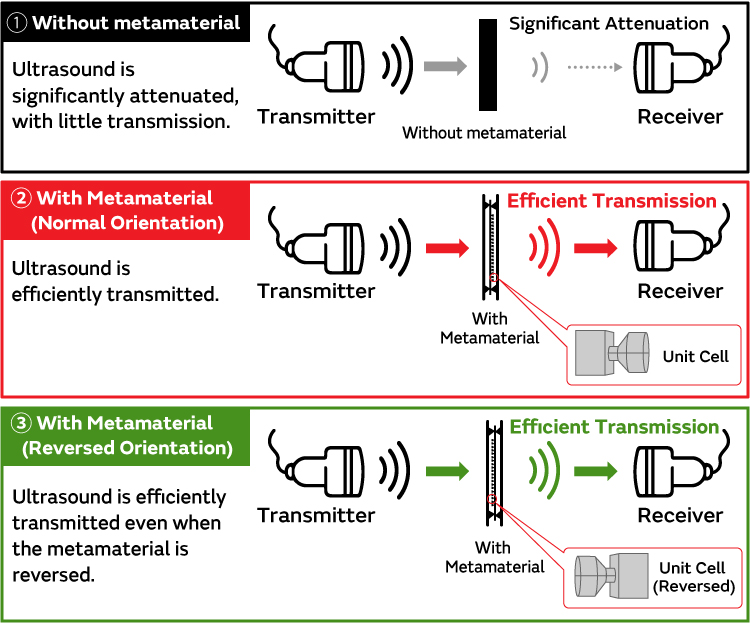
Pulse-echo ultrasonic sensors rely on transmitted and returning ultrasound passing through the plate, which makes bidirectional passthrough essential.
In Murata's ultrasound transmission metamaterial, both the unit cells and the plate vibrate at the resonant frequency, assisting ultrasound transmission. As a result, ultrasound can be transmitted regardless of which side the wave is incident from.
The simulation results below confirm that comparable transmission performance is achieved whether the metamaterial is installed in its normal orientation or with its front and back sides reversed.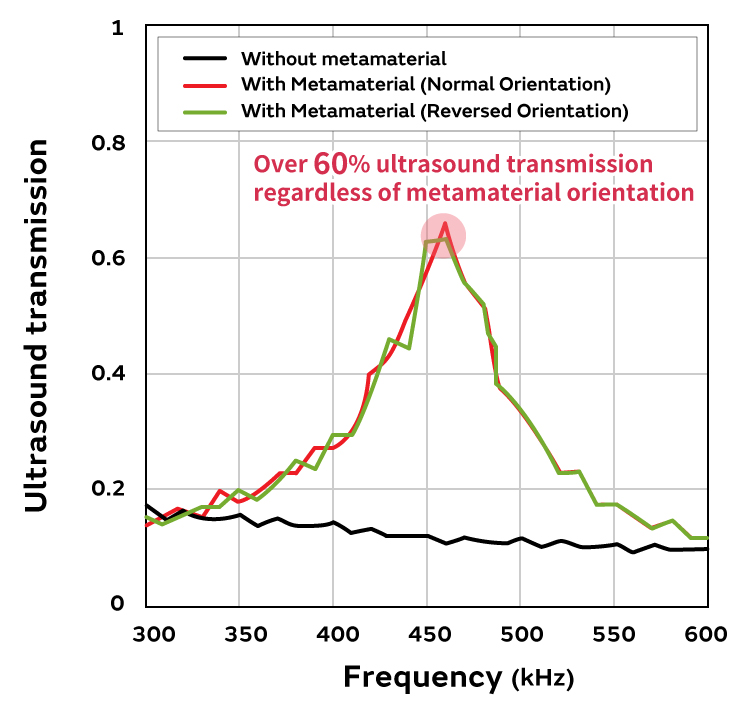
 Please flick to see
Comparison of transmission with
the metamaterial facing different directions
Applications of Murata’s Ultrasound Transmission Metamaterial

Area of Application 01 In-Vehicle Sensing
The metamaterial may enable ultrasonic sensor installation behind exterior vehicle components such as bumpers and doors.
Sensing without exposed sensor units promises a way to balance vehicle safety and appearance.

Area of Application 02 Pipe Flow Measurement
Flow measurement is another promising application, with ultrasound transmitted from externally mounted ultrasonic sensors through pipe walls to measure the flow of gas or liquid inside.
This can support flow monitoring without requiring openings in pipes or direct contact between sensors and the flow.

Area of Application 03 Liquid Level Measurement
The technology can also be useful for liquid level and remaining-volume measurement in tanks, with ultrasound transmitted from the top of the tank through the air inside above the liquid.
By enabling efficient ultrasound transmission through air, it provides greater flexibility in sensor placement.
FAQ
Periodically arranged mass-spring resonators are designed to resonate at specific ultrasonic frequencies. They receive incident ultrasonic waves as mechanical vibrations and then re-remit them in the opposite direction. This enables ultrasound transmission even between materials with different acoustic impedances.
The size of the unit cell depends on the target ultrasonic frequency. Therefore, it is possible to adjust the design and shape of the metamaterial to suit specific frequencies.
The applicable frequencies range from the kHz band to the MHz band. In principle, even the GHz band can be supported. However, the wavelengths become extremely short, so processing and manufacturing becomes more difficult.
The technology of this ultrasound transmission metamaterial makes it easy to use for harder materials such as metal or plastic. To ensure sufficient transmission through soft or porous materials which tend to attenuate ultrasound, it may be necessary to review the metamaterial specifications.
Yes, ultrasound can pass through a gaseous medium when the metamaterial is used.
Gaseous media are quite different from other materials in terms of acoustic impedance, which usually makes ultrasound transmission more difficult. However, by designing the metamaterial for the particular installation environment or target objects, transmission efficiency can be enhanced even for gaseous media.
Message From the Developers

-
Murata Manufacturing Co., Ltd.
Mudassir Hussain
Material Process Development Dept. Material Technology Center Technology & Business Development Unit
Masaya NishidaWe invite you to join us in expanding the horizons of ultrasonic technology.
Murata's revolutionary ultrasound transmission metamaterial technology has the unique capability to enable ultrasonic waves to pass through obstacles placed in a variety of media. This breakthrough opens up a multitude of possibilities across various industries, including medical imaging, automobiles, underwater acoustics, etc.
At Murata, we firmly believe in the power of collaboration and co-creation. We eagerly welcome partners from all industries utilizing ultrasonic sensors to embark on this exciting journey with us. Together, let's explore innovative applications and extend the boundaries of what can be achieved with ultrasonic technology.
News
-
We have updated the “Ultrasound Transmission Metamaterial” development theme, for which we are looking for collaboration partners.
-
We have published a technical article titled “What Are Materials That Expand Possibilities with Behavior Not Found in Substances in the Natural World?”
-
We have published a technical article titled “‘Ultrasound Transmission Metamaterial’ that Expands the Range of Places where Ultrasonic Sensors Can Be Used to Include Medicine and Automobiles.”
-
We have posted the ultrasound transmission metamaterial development theme for which we are looking for collaboration partners.
Read More


Inquiries
Please feel free to Contact Us if you are interested in the new ultrasound transmission metamaterial that enhances ultrasound transmittance thanks to our unique technology, or if you want to learn more about this technology.
*This product is under development. Therefore, the specifications are subject to change without prior notice.