
Partner With Us - Current Themes
Realizing output up to four times greater than conventional batteries
Next-generation lithium-ion secondary batteries using porous current collectors
Recommended for:
- Companies holding porous polymer film technologies and their scalabilities
- Companies having metal coating technologies and their scalabilities
- Companies seeking high-power and high-energy density batteries
- Companies persuing the extremely fast charging of lithium ion secondary batteteris
Porous current collector
Introduction of Next-Generation Lithium-Ion Secondary Batteries Using New Technology "Porous Current Collectors"
03:19
In conventional lithium ion secondary batteries, there has been an issue : when we use the thicker electrodes to increase the energy density, the resistance increases as the lithium ion transport discance gets longer, reducing the maximum current, decreasing the power of the battery.
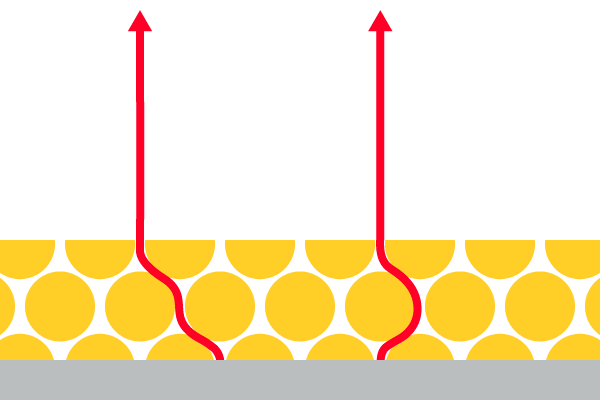
when the electrodes are thin
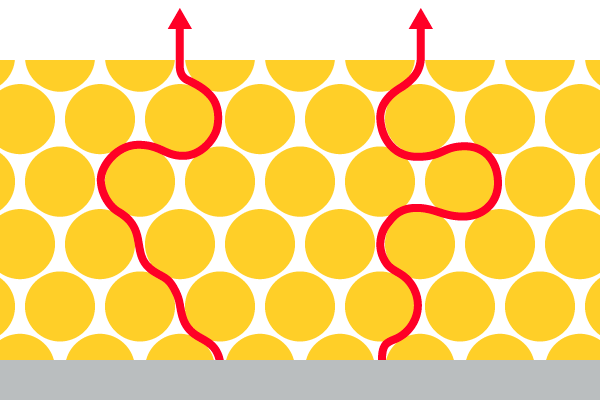
the electrode gets thicker
We have developed a porous current collector to solve this issue.
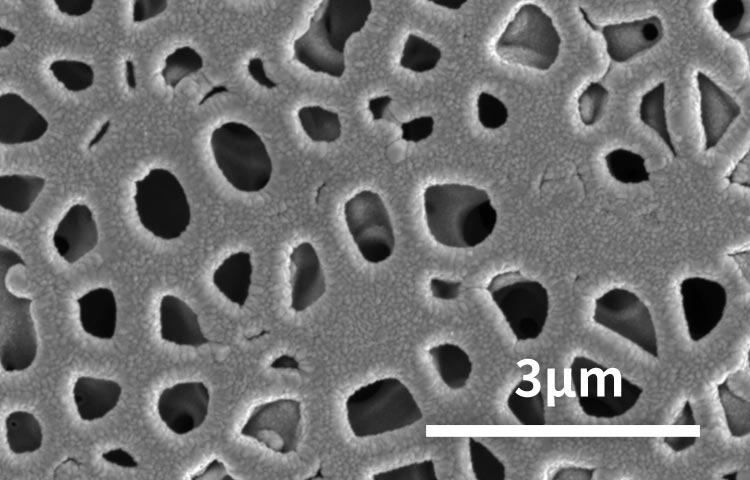
*Images provided:Stanford University
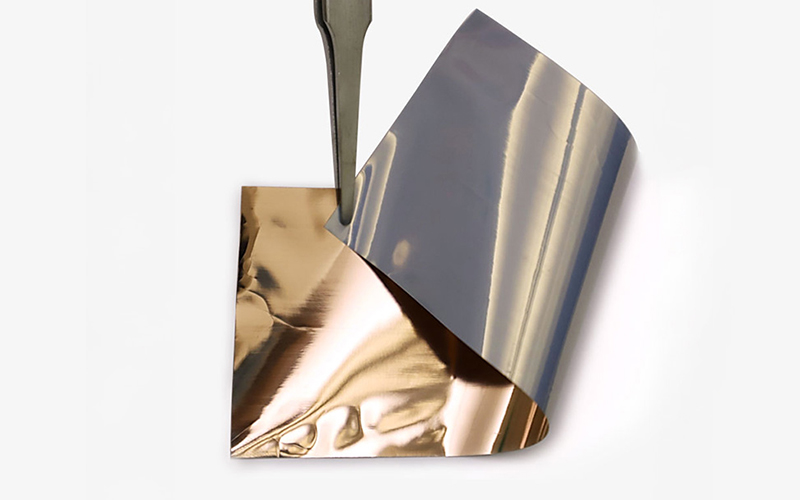
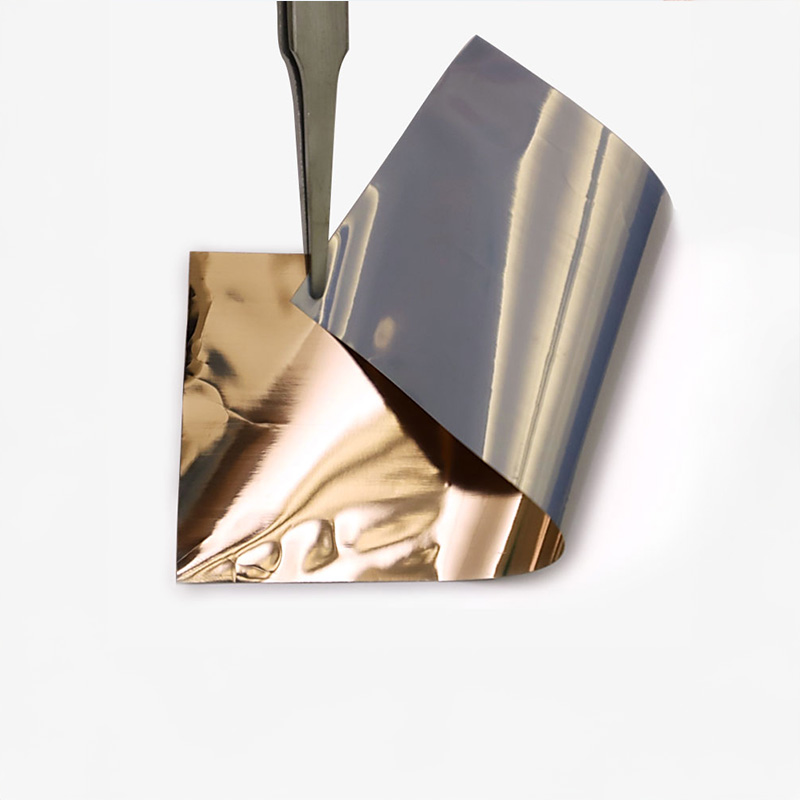
Lithium ion secondary batteries using traditional current collectors have a structure in Fig. A. Cathodes are located on the aluminum foils, while anodes on the copper foils on both sides. The lithium ions then travel between the two electrodes through separators (blue arrows). On the other hand, porous current collectors in Fig. B, consists of a porous polymer film as a matrix, coated with two types of metals on the surface, aluminum on one side and copper on the other without filling the pores.
Placing cathodes on the aluminum sides while anodes on the copper ones, lithium ions are allowed to move through the current collectors (red arrows). As a result, lithium ion transport distance is shortened by one half, reducing resistance, and allowing more current to flow than before.
Fig.A : Traditional current collector (TCC)
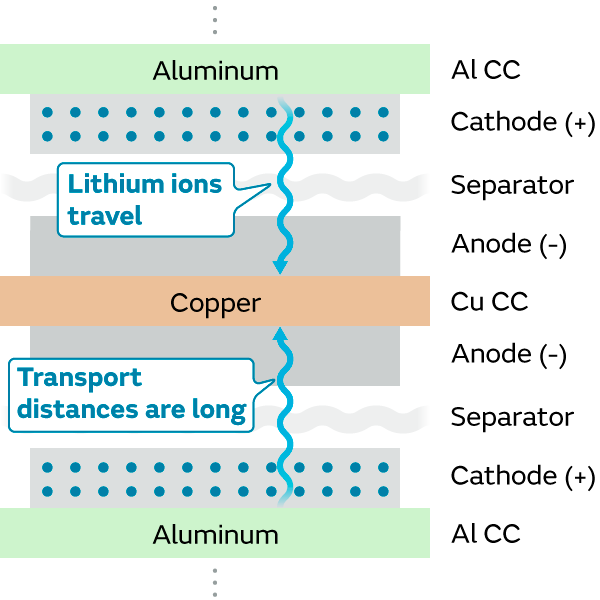
 Ion pathway through separator
Fig.B : Porous current collector (PCC)
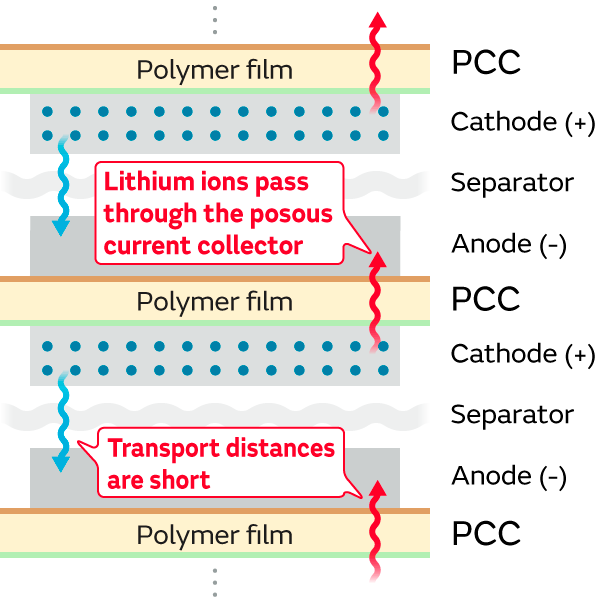
 Ion pathway through porous current collector
Differences in the structures of traditional current collectors (TCC) and porous current collectors (PCC)
Next-generation lithium ion secondary batteries using porous current collectors
Quadrupling the power of lithium ion secondary batteries
Implemantation of porous current collectors into the lithium ion secondary batteries will allow twice the current to flow at muximum, resulting in the fourfold power generation, and reducing the charging time to one quarter compared to the conventional lithium ion secondary batteries with traditional current collectors.
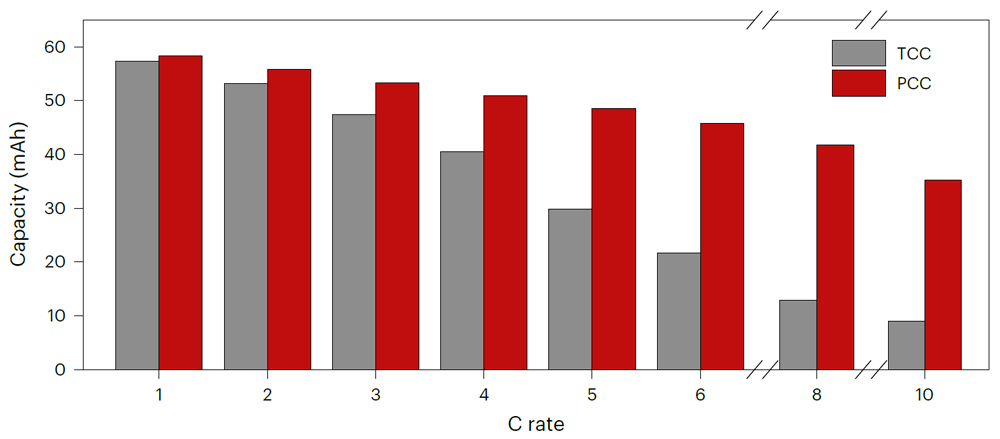
using traditional current collectors (TCCs) and porous current collectors (PCCs)2
Weight reduction of lithium ion secondary batteries
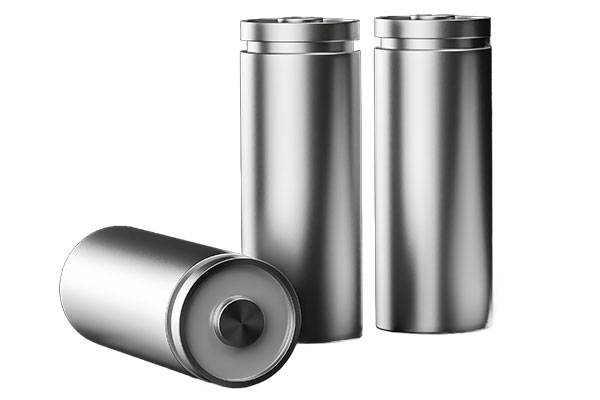
Aluminum and cooper foils are used as the traditional current collectors in Lithium ion secondary batteries. Suppose porous current collectors are used in a cylindrical cell (21700 size) instead of traditional current collectors, the weight would be reduced by about 10% due to the lighter weight of their polymer matrix. Since the amount of electrodes are equal in this estimation, the energy density is expected to increase by about 10%. Porous current collectors are the technology that can improve the power and fast-charging properties without compromising, or even increasing energy densities.
Safety improvement of lithium ion secondary batteries
It has been reported that lithium ion secondary batteries using metal-polymer composite current collectors showed the superior battery safeties, exhibiting the prevention of thermal runaway.3,4,5
These references suggest the possibility that porous current collectors would improve the battery safeties of lithium ion secondary batteries through the prevention of thermal runaways.
Perspectives
Porous current collector is compatible with existing battery manufacturing processes both for cylindrical and laminated types, indicating that next-generation lithium ion secondary batteries with porous current collectors would be applied to all devices in which the present lithium ion secondary batteries are currently used.
Moreover, as the enhancements with this technology become greater the larger the batteries, it would be possible to apply next-generation lithium ion secondary batteries into the fields where it has not been possible to apply them before.
FAQ
It is possible to increase the output up to four times and to reduce the charging time to one quarter at the shortest compared to when using conventional current collectors. In addition, it is also possible to expect the benefit of enhancing battery safety.
Ions can move through the porous current collector. This shortens the distance the ions move. As a result, it is possible to keep resistance low even with a thick electrode. This enables large currents to flow.
The principles of porous current collectors have been confirmed through joint research with Stanford University. Please check the paper given in the references section for details.
Inquiries about Next-generation Lithium-ion Secondary Batteries using Porous Current Collectors
Please feel free to contact us if you are interested in next-generation lithium-ion secondary batteries using porous current collectors that can be expected to provide output up to four times greater than conventional batteries, or if you want to learn more about this technology.
*This product is under development. Therefore, the specifications are subject to change without prior notice.
Message from the developers


Murata Manufacturing Co., Ltd.
Energy storage technology development department 1 Device Center, Corporate Technology & Business
Development Unit
-
Yuri Nakayama
Yoshiaki Suzuki
Yasuyuki Masuda
Takahiro Yuuki - We at Murata Manufacturing are carrying on the history of lithium ion secondary batteries interited from Sony. Recently, we have developed a porous current collector together with Stanford University. Murata Manufacturing is now trying to change the history of energy through the development of lithium ion secondary batteries with porous current collectors, ensuring that this battery evolution spread throughout the world. We would like to accomplish this innovation together with you to create the future of the earth.
References
- (1)Yusheng Ye, Rong Xu, Wenxiao Huang, Huayue Ai, Wenbo Zhang, Jordan Otto Affeld, Andy Cui, Fang Liu, Xin Gao, Zhouyi Chen, Tony Li, Xin Xiao, Zewen Zhang, Yucan Peng, Rafael A. Vila, Yecun Wu, Solomon T. Oyakhire, Hideaki Kuwajima, Yoshiaki Suzuki, Ryuhei Matsumoto, Yasuyuki Masuda, Takahiro Yuuki, Yuri Nakayama & Yi Cui, “Quadruple the rate capability of high-energy batteries through a porous current collector design”, Nature Energy 9, 643-653 (2024).
- (2)Yusheng Ye, Rong Xu, Wenxiao Huang, Huayue Ai, Wenbo Zhang, Jordan Otto Affeld, Andy Cui, Fang Liu, Xin Gao, Zhouyi Chen, Tony Li, Xin Xiao, Zewen Zhang, Yucan Peng, Rafael A. Vila, Yecun Wu, Solomon T. Oyakhire, Hideaki Kuwajima, Yoshiaki Suzuki, Ryuhei Matsumoto, Yasuyuki Masuda, Takahiro Yuuki, Yuri Nakayama & Yi Cui, “Quadruple the rate capability of high-energy batteries through a porous current collector design”, Nature Energy 9, 643-653 (2024).
- (3)Martin T.M. Pham, John J. Darst, William Q. Walker, Thomas M.M. Heenan, Drasti Patel, Francesco Iacoviello, Alexander Rack, Margie P. Olbinado, Gareth Hinds, Dan J.L. Brett, Eric Darcy, Donal P. Finegan, Paul R. Shearing, “Prevention of lithium-ion battery thermal runaway using polymer-substrate current collectors”, Cell Reports Physical Science 2, 100360 (2021).
- (4)Zhikang Liu, Yanhao Dong, ORCID Xiaoqun Qi, Ru Wang, Zhenglu Zhu, Chao Yan, Xinpeng Jiao, Sipei Li, Long Qie, Ju Li and Yunhui Huang, “Stretchable separator/current collector composite for superior battery safety”, Energy & Environtal Science 15, 5313 (2022).
- (5)Yong Peng, Xuning Feng, Jianzhong Xia, Zesheng You, Fangshu Zhang, Yiwei Chen, Congze Fan, Jianfeng Hua, Yubo Lian, Zhongde Shan, Minggao Ouyang, “Polymer based multi-layer Al composite current collector improves battery safety”, Chemical Engineering Journal 491, 151474 (2024).
Notices
-
Murata Manufacturing and Stanford University Collaborate to Create the World’s First Porous Current Collector, Quadrupling Battery Power
-
We posted the next-generation lithium-ion secondary batteries development theme for which we are looking for collaboration partners.

Inquiries
Please feel free to contact us if you are interested in next-generation lithium-ion secondary batteries using porous current collectors that can be expected to provide output up to four times greater than conventional batteries, or if you want to learn more about this technology.
*This product is under development. Therefore, the specifications are subject to change without prior notice.