
Partner With Us - Current Themes
Revolutionizing the making of electronic devices
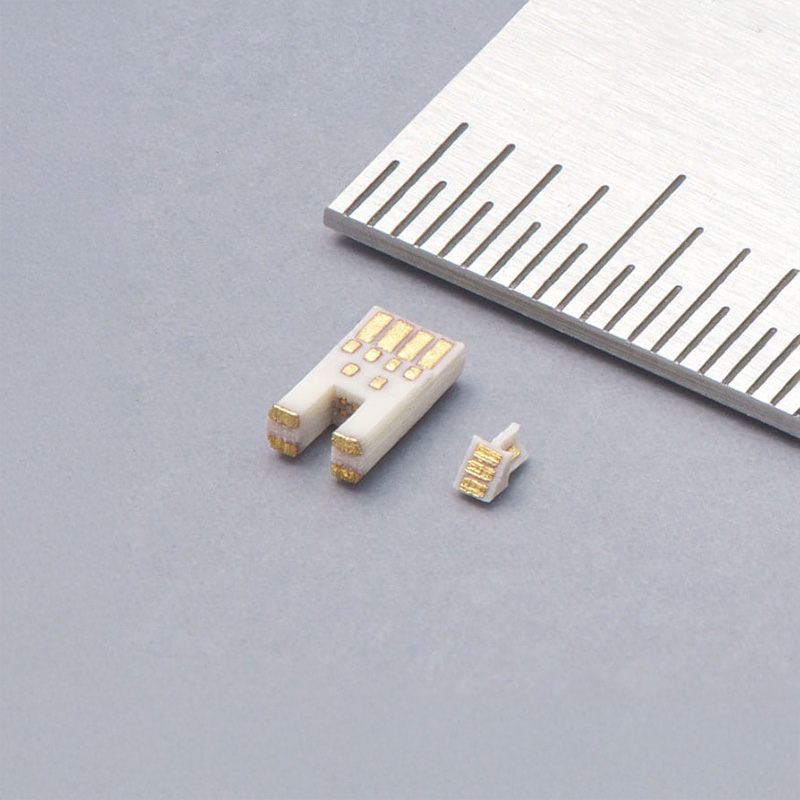
3D-printed ceramic circuit board NeuroStoneTM
Recommended for:
- Medical device manufacturers having trouble with device downsizing and heat dissipation
What is NeuroStoneTM?
We coined the name NeuroStoneTM by combining "neuron" (nerve cells in the
brain) and "stone"
(ceramics). At Murata, we have traditionally referred to ceramics as "wonder stones."
The idea for this product came from using these wonder stones to create a circuit board resembling a
neural network in the brain, which is ideal natural prototype.
Murata's proprietary 3D printing technology allows us to print in any shape, enabling
three-dimensional multi-directional internal wiring. We can create uneven surfaces and cavities with
high packing density of electrodes inside the module, allowing you to miniaturize and enhance the
functionality of equipment design by optimal arrangement other components.
Additionally, NeuroStoneTM has high dissipation performance thanks to its metal
wiring and heat
insulation properties provided by its ceramics. This ensures temperature control to prevent harm to
the body.
This combination of characteristics can help reduce the size and increase the functionality of
industrial equipment, as well as make medical equipment less invasive.
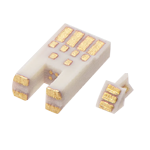
NeuroStoneTM
|
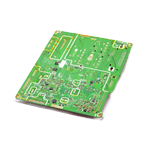
PCB
|
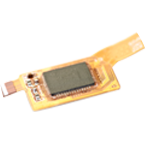
FPC
|
Ceramic circuit board
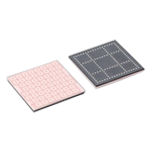
|
MID
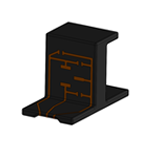
|
|
|---|---|---|---|---|---|
| Degree of freedom - free-form | Excellent
Fully 3D design *1 |
Poor | Average | Average | Good |
| Heat resistance | Good
300°C/572°F > *2 |
Average | Average | Excellent | Average |
| Degree of freedom in wiring thickness (=Heat dissipation) |
Excellent
About 0.2mm *3 |
Excellent | Poor | Good | Poor |
| Size range of circuit board that can be manufactured | Average | Good | Good | Average | Excellent |
- NeuroStoneTM Advantages
-
*1 Expansive form flexibility enables full 3D design.
*2 NeuroStoneTM is fabricated by co-firing at just under 1,000°C/1,830°F, giving it heat resistance up to over 300°C/572°F
*3 Wiring can be printed to a metal thickness of approximately 0.2 mm, providing excellent heat dissipation, electrode packing density and multi-directional interconnect freedom
Heterogenous material integrated 3D-printing technology that can only be warranted by a long-established ceramic electronic component manufacturer
Freely printed from three different materials
NeuroStoneTM manufacturing process
- The 3D-printed small free-form inter-connected ceramic devices are fabricated from three distinct materials: ceramics, conductive metal, and a support material for keeping the shapes.
- These materials are layered to achieve the desired shape.
- During the co-firing process, the support materials are burned off, leaving behind the printed ceramics and metals. This results in a three-dimensional free-form ceramics and metal electrodes inside and outside.
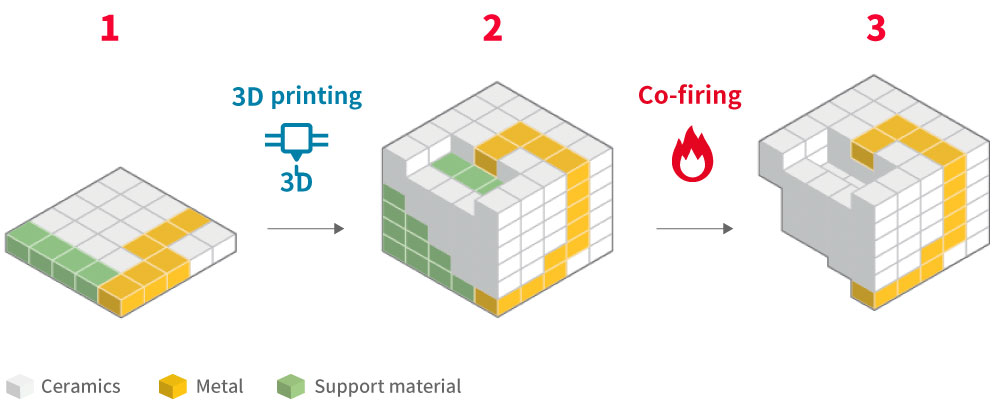
Murata's proprietary know-how is effectively used in the process from material development to cofiring.
We developed NeuroStoneTM by accumulating a wide range of technological
innovations, including
next-gen 3D printer-suitable ink development and firing control.
For instance, if materials are simply mixed together, the ink will settle and separate, making it
unsuitable for 3D printing. Therefore, it is essential to skillfully mix the materials to create
stable ink formula.
Additionally, co-firing different types of materials together during fabrication is challenging.
Different materials exhibit varying shrinkage behaviors during cofiring. If only one material
shrinks, stress occurs between the heterogeneous materials, potentially causing them to break. It is
crucial to control the co-firing temperature and the gas in the firing furnace to ensure the
materials join together without breaking.
Murata has cultivated expertise in material development and firing after years of research and
testing. The expertise has enabled us to overcome ink and firing challenges to develop NeuroStoneTM.
Benefits of NeuroStoneTM using
Downsize and increase functionality and reliability of equipment by optimal placement of components
Downsizing Equipment:
You can now custom design components to fit in the free space of your equipment. This design flexibility provides you the ability to maximize the space requirements and ultimately leads to a downsizing of your equipment and miniaturizing your devices.
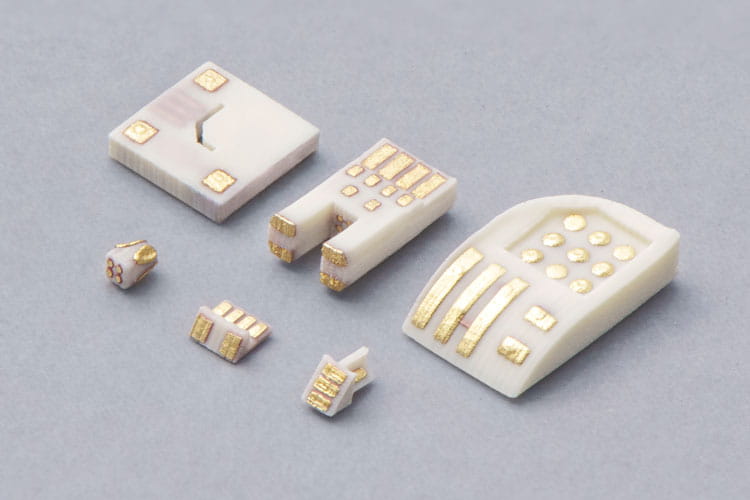
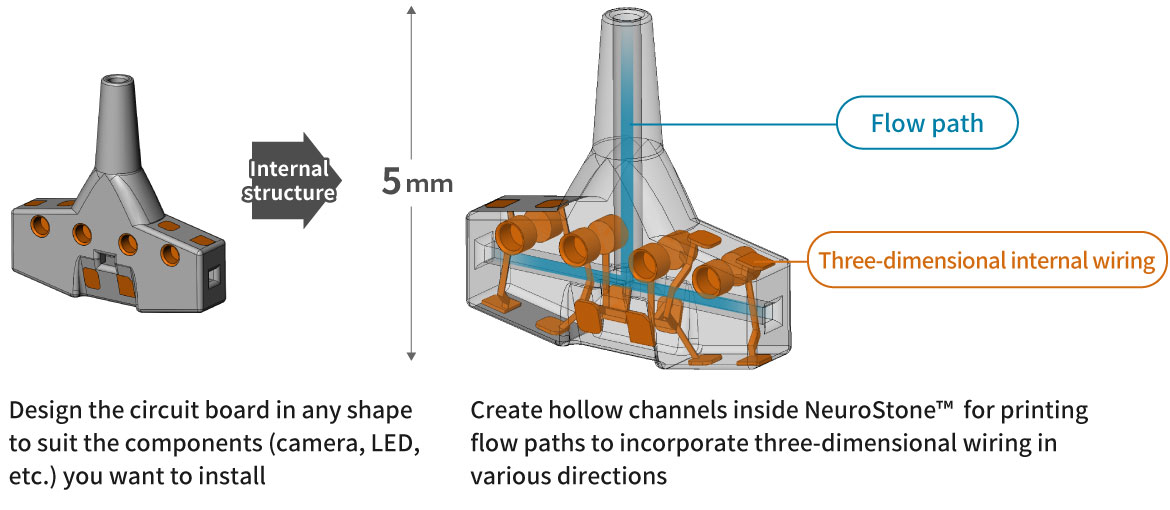
Incorporating Three-Dimensional Internal Wiring:
Unlike conventional flat circuits (PCBs, FPCs), it is now possible to design wiring three-dimensionally in multiple directions. This allows for efficient wiring connections and the adjustment of the number and position of components, leading to the creation of more functional equipment.
Designing Unevenness and Cavities:
By designing ridges and cavities inside NeuroStoneTM, LEDs, sensors,
and other equipment can
be installed in internal hollow channels. Flow path printing for fluids is also possible.
Sensors can be positioned and oriented for easy sensing, enabling higher precision sensing.
With the above benefits, NeuroStoneTM can improve reliability and facilitate the development of the next generation device beyond the role of a simple circuit board.
Possesses both high heat resistance and heat dissipation
Using various functional components on a circuit to enhance functionality can lead to increased
electricity flow, which in turn generates more heat.
If components produce heat, they could potentially harm the body. Thus, temperature control is
crucial.
NeuroStoneTM offers excellent heat dissipation due to its metal wiring and
effective heat insulation
provided by its ceramics. This allows it to channel heat along an optimal path, preventing harm to
the body.
Additionally, it is fired at nearly 1,000°C/1,830°F, giving it high heat resistance.
Contributing to making medical care minimally invasive
We anticipate that NeuroStoneTM will be particularly valuable to medical and industrial equipment manufacturers looking to reduce the size of their devices. Our small free-form inter-connected ceramic 3D printing technology allows for the production of small circuit boards measuring just a few millimeters. For example, we envision NeuroStoneTM being used at the tips of endoscopes, different electric catheters, and other medical instruments. It is crucial to accurately integrate various electronic components into these compact devices that are inserted into the body. With NeuroStoneTM, each component can be optimally arranged, enabling equipment downsizing. This innovation facilitates the development of devices that impose less strain on the body, ultimately contributing to a less invasive medical care solution.
NeuroStoneTM utilization examples
Endoscopes
Optimal component placement makes endoscopes smaller and less invasive
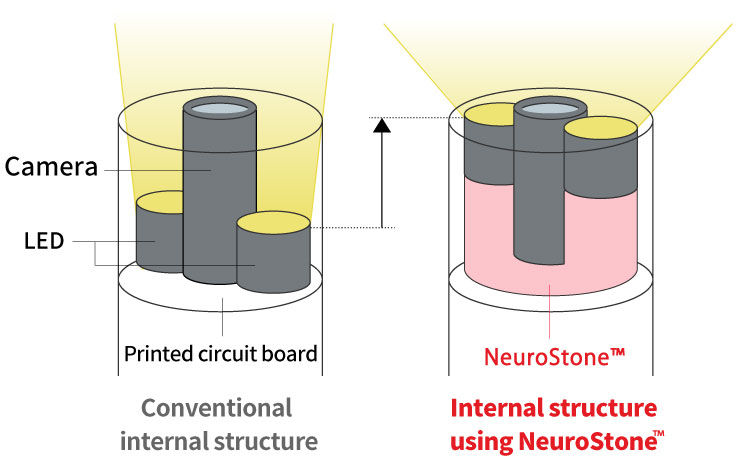
It is possible to make any shape, and place the lighting and other functions in even more optimal places
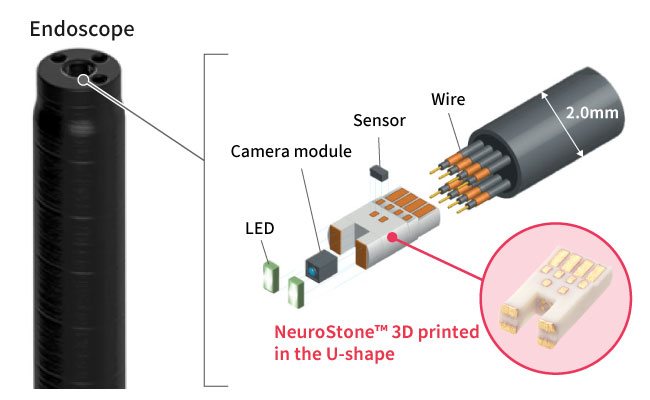
Endoscopes inserted into the body require various electronic components housed within a thin tube.
It is crucial to align the LED light with the camera for effective illumination. Traditional
methods of bending film-like boards often fail to achieve this precision.
However, NeuroStoneTM devices can be 3D printed into unique shapes. By
utilizing a U-shaped
NeuroStoneTM, we can precisely position components in smaller devices,
enabling endoscopes that
efficiently illuminate internal structures of the body.
Catheters
Improve functionality by tilting the sensor in a specific direction
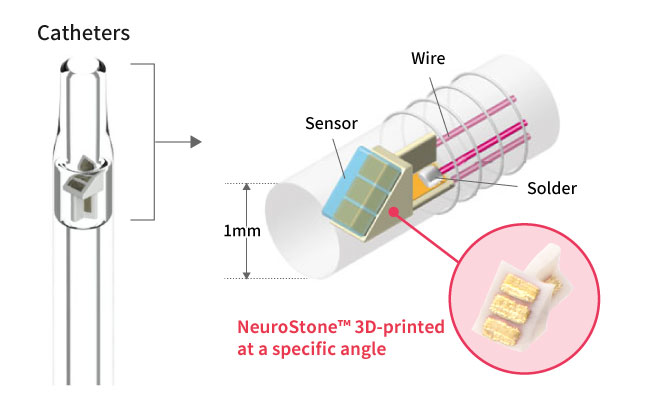
Electric catheters inserted into blood vessels are quite small, measuring about 1 mm in diameter. This necessitates positioning the sensor at a specific angle inside the device. Traditional methods of combining printed circuit boards with resin components often struggle to achieve this precise angle. In contrast, NeuroStoneTM allows us to mold the ideal angle for optimal sensing in advance, making it easier to integrate the sensor. This approach maximizes the functionality of the sensor and enhances the precision of medical equipment.
FAQ
We can expect it to be utilized in devices for which downsizing and higher functionality is sought such as endoscopes and catheters.
It is possible to make circuit boards with a small size of 5 mm or less.
One main difference is that it is possible to form cavities because it is shaped using a 3D printer. The other main difference is that it has high resolution in the thickness direction to enable three-dimensional wiring because a printing plate is not required.
Mounting is possible by hand soldering or reflow soldering at the development level. We are currently developing mounting methods suitable for mass production. Therefore, we would like to think together with you about the optimal method when proceeding with joint development.
We can handle production quantities with a view to mass production. The specific production capacity depends on the product size. Therefore, we will present details about this as we proceed with joint development.
Inquiries about the NeuroStoneTM 3D-printed Ceramic Circuit Board
Please feel free to contact us if you are a product developer having trouble with device downsizing and heat dissipation, and you would like to collaborate with Murata Manufacturing.
*This product is under development. Therefore, the specifications are subject to change without prior notice.
Message from the developers

Murata Manufacturing Co., Ltd.
NeuroStoneTM Development Unit
- Takumi Okashiro
-
NeuroStoneTM is a distinctive product exclusively developed by Murata, leveraging
our expertise in ceramic electronic components. We believe that NeuroStoneTM will
lead to technological
innovations that will reduce the size and increase the functionality and reliability of your
products.
Currently, this product is still in development, and we face several challenges before bringing it to market. However, we are excited to collaborate with partners who can help us overcome these obstacles and achieve innovation together.
Notices
-
We posted the NeuroStoneTM development theme for which we are looking for collaboration partners.
-
We exhibited at the MD&M West 2025 exhibition.

Inquiries
Please feel free to contact us if you are a product developer having trouble with device downsizing
and heat dissipation, and you would like to collaborate with Murata Manufacturing.
*This product is under development. Therefore, the specifications are subject to change without
prior notice.