

Partner With Us - Current Themes
Rapidly and stably detecting and quantifying faint odors
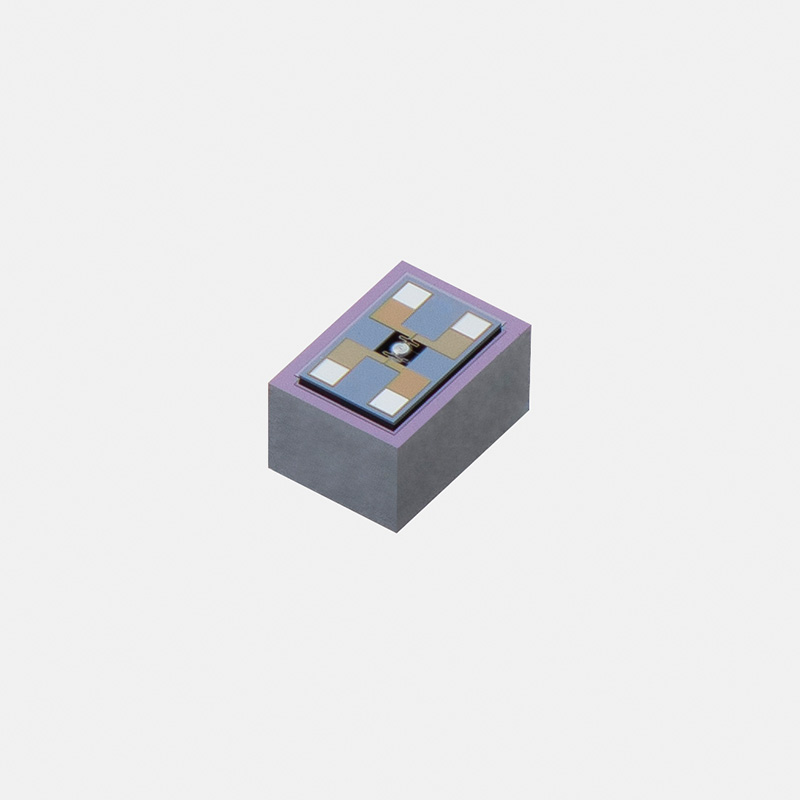
Olfactory sensor
Recommended for:
- Companies wishing to handle the odors currently evaluated using the human sense of smell as data
- Companies interested in odor sensing in high-humidity environments
- Companies wanting to consider new solutions using odor sensing that combines sensors and algorithms
Mechanical realization of the sense of smell, often called the "last frontier" of the five senses
Odors: Complex targets consisting of a mixture of many chemical substances
Sensing technology capable of replacing the human sense of smell has lagged somewhat behind technologies for the other senses. Practical application of such technology is still considered a work in progress. The development of olfactory devices is so challenging that the human sense of smell is often called the "last frontier" of the five senses. This is because it involves complex information processing in which the olfactory receptors, which serve as the sensory organs, and the brain, which serves as the central nervous system, are closely interconnected.
To begin with, when humans perceive odors with the sense of smell, approximately 400 types of olfactory receptors located in the nasal cavity react to a complex mixture of gas molecules and send intricate combinations of neural signals to the brain. The brain instantaneously identifies the gas molecules by processing these neural signal patterns in an integrated manner. In other words, unlike conventional gas sensors designed to detect a limited number of molecules such as carbon dioxide or methane, olfactory devices detect far more complex targets.
Quantification made possible by improvements in analytical capabilities
The attention of those seeking to develop olfactory devices at a practical level has been focused on AI technology since the mid-2010s. As AI technology has advanced, the hurdle for the identification of odors, which is the latter part of the olfactory mechanism, has been lowered. Today, the race to develop practical olfactory devices is accelerating in the area of technology that mechanically mimics olfactory receptors. In other words, the focus is on the detection of odors, and the development of practical olfactory devices continues to advance.
Murata has been advancing a project to commercialize olfactory devices since 2019. It is possible to leverage Murata's strengths in sensing design technology by viewing olfactory receptors as a type of sensor element, and in 2025, we announced an olfactory sensor as a PoC model.
Murata's olfactory sensing technology inspired by human olfaction
Realizing an olfactory detection process using a sensor unit and AI
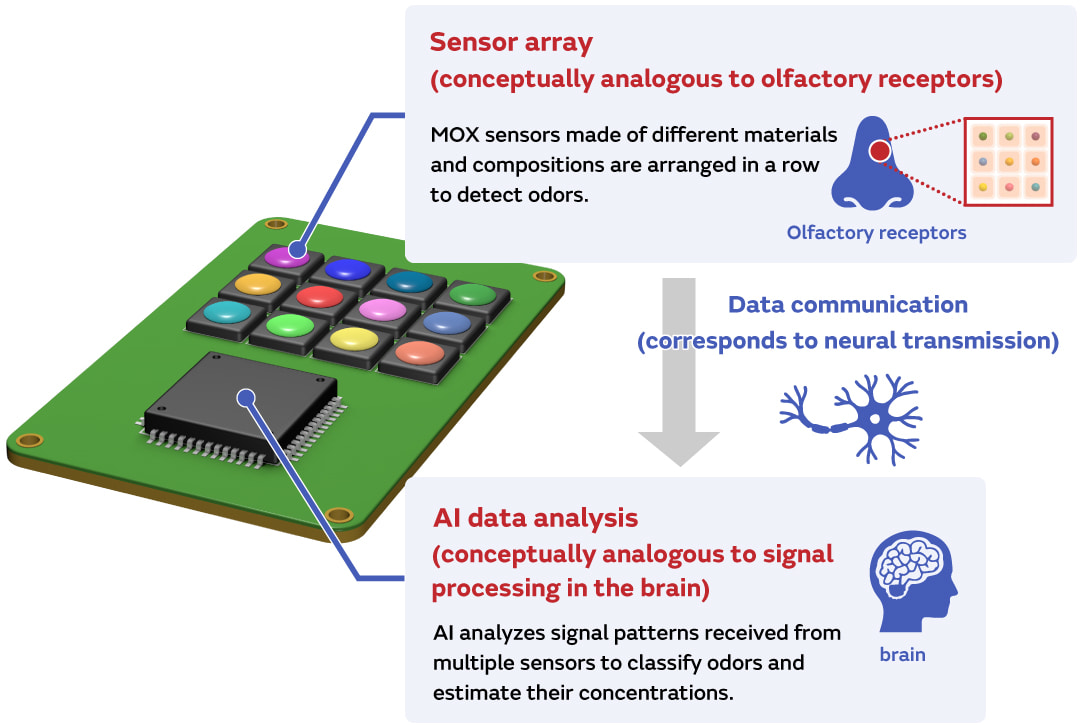
Murata's olfactory sensor is divided into a sensor unit that corresponds to the olfactory receptors concentrated in the nasal cavity and a data analysis unit that fulfills the role of the brain. When the sensor unit responds to gas molecules that are the source of odors, an electrical signal pattern is sent to the data analysis unit. The system then classifies the odor or fragrance through an AI algorithm.
MOX sensor elements that generate electrical signals from odors
Metal oxide (MOX) sensor elements are responsible for the olfactory receptor function. Multiple MOX sensor elements are lined up in the sensor unit. This mimics the olfactory receptors, which are densely packed in the nasal cavity. Furthermore, each MOX sensor element in the sensor unit has a different composition. This results in the generation of complex electrical signal patterns from the sensor unit.
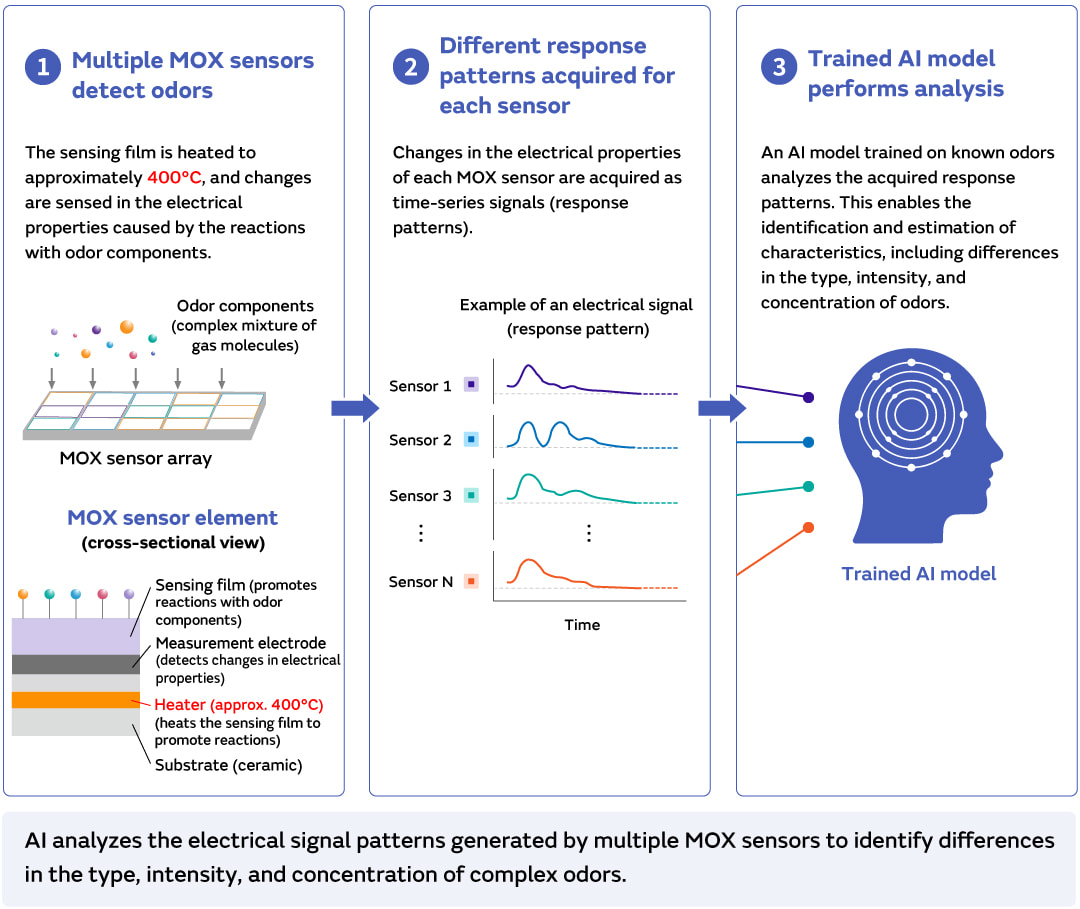
The sensing film on the surface of the MOX sensor elements acts as a catalyst for redox reactions. This causes electrons to move between the gas molecules and sensing film, resulting in the electrical resistance in the MOX sensor elements changing over time. The behavior of this electrical resistance differs depending on the type of gas molecule. In other words, integrating multiple types of MOX sensor elements leads to unique electrical signal patterns emerging as combinations of graphs for each odor. Furthermore, a heater that generates heat at approximately 400°C is embedded in the base of the MOX sensor elements to enhance detection sensitivity by promoting redox reactions.
Murata's know-how in multilayer ceramic capacitors and MEMS gyro sensors is being utilized in the development of these components.
Enabling odor classification and linking with linguistic information
Odors, which consist of a complex mixture of gas molecules, have a countless number of variations. If even a small amount of an irregular gas molecule is added to a composition, the electrical signal pattern changes drastically even if the nature of the odor remains largely the same. Conversely, completely different odors can sometimes produce electrical signal patterns that appear remarkably similar at first glance. In this way, the electrical signal patterns sent from the sensor unit of the olfactory sensor device to the analysis unit are extremely difficult to understand. In other words, direct analysis by humans to identify odors is impractical.
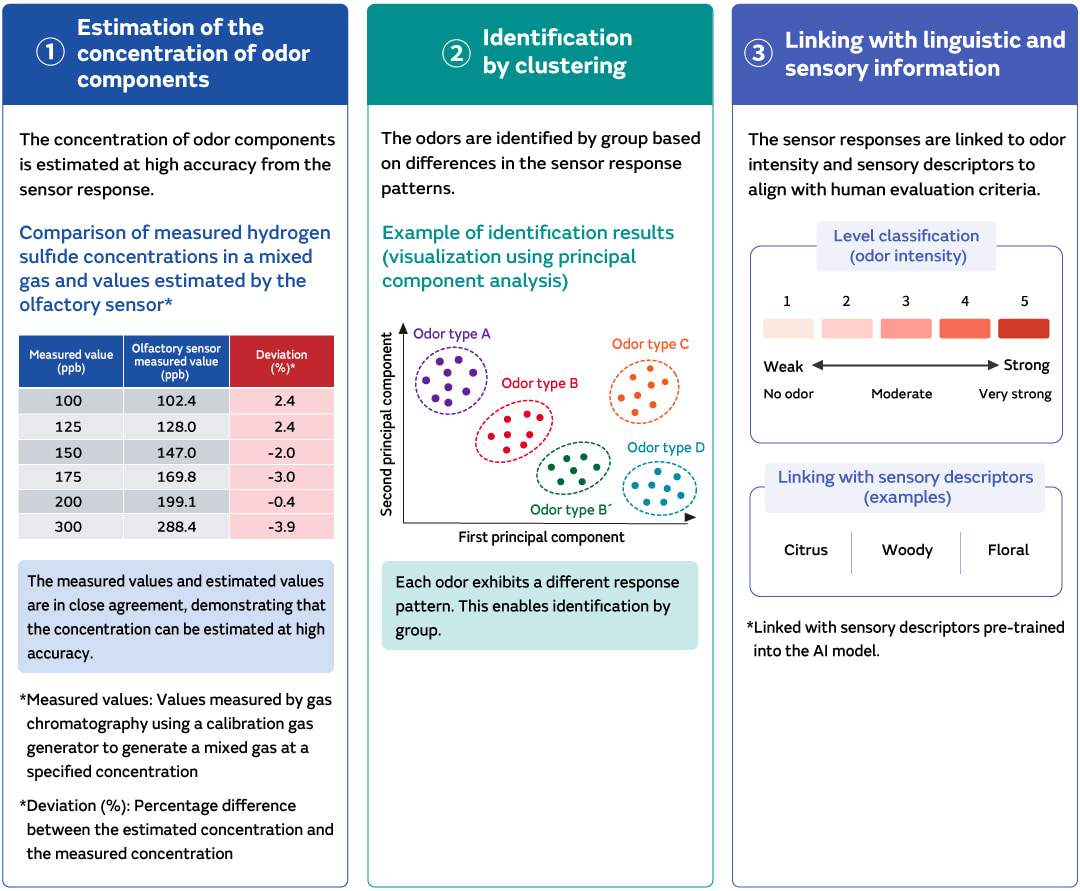
To analyze these complex electrical signal patterns, we implemented an AI algorithm that we had independently developed into the olfactory sensor. We then pre-trained the AI model on the electrical signal patterns of known odors to make it possible to classify complex mixtures of gas molecules as odors through a neural network.
Furthermore, implementing the AI algorithm has expanded the range of applications. For example, the electrical signal patterns generated by the sensor unit vary depending on both the odor's composition and its concentration, so it is possible to estimate the concentration of gas molecules as well. This technology can also be applied in other ways, for example, by linking the odor identification criteria with sensory descriptors.
Murata's proprietary technology that rapidly and stably detects faint odors
-
Feature
Detection sensitivity that rivals the sense of smell of a skilled professional
Please flick to see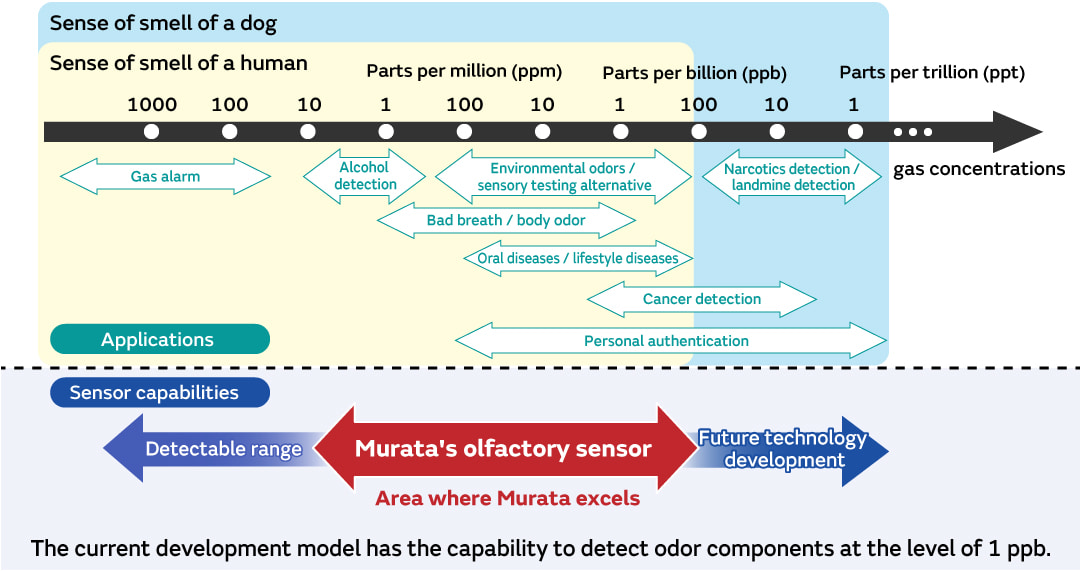
Detection Capabilities of the olfactory sensor In general, the detection sensitivity of existing gas sensors is in the ppm range. In contrast, Murata's olfactory sensor device detects odors at 1 ppb. To describe this detection sensitivity in terms of the sense of smell of humans, it is at a level that rivals skilled professionals who conduct environmental odor and sensory testing, as well as individuals sensitive to bad breath or body odors. It can also be described as a level of sensitivity capable of detecting conditions such as oral diseases and lifestyle diseases. Therefore, the olfactory sensor can be expected to be applied to a wide range of fields as its classification capabilities continue to improve through the accumulation of datasets and other means.
-
Feature
Measurement time reduced from several tens of minutes to just five seconds
Previously, detecting odors using equipment required at least several tens of minutes. However, depending on the evaluation conditions, Murata's olfactory sensor can detect odors in as little as five seconds*.
* Detection time varies depending on the evaluation conditions.
The secret behind the sensor's speed and sensitivity lies in the MOX sensor element sensing film. Made of ceramic material, this sensing film features a highly controlled porous structure. Moreover, its thickness is on the nano-scale. This allows gas molecules to easily reach deep into the sensing film at high speed, causing larger and more rapid changes in electrical resistance. High-speed detection of faint odors is possible as a result.
Please flick to see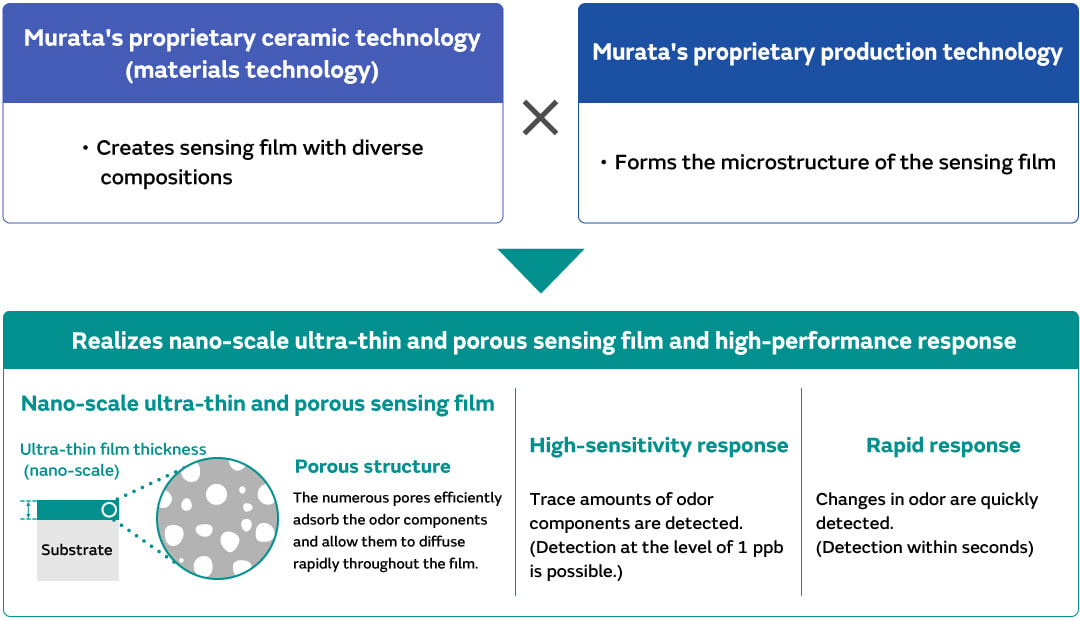
Thin film technology that delivers high sensitivity and rapid response -
Feature
High robustness against changes in humidity
Optimizing the material composition of the ceramic element also leads to resistance against changes in humidity. In fact, verification results indicate that the output is stable even when the humidity changes.
The data below shows the humidity dependence of the sensor response. We measured the response to 10 ppb of hydrogen sulfide while changing the ambient humidity from 20% to 80%. In all cases, the changes in the readings remained within ±10% of the reference value.
Please flick to see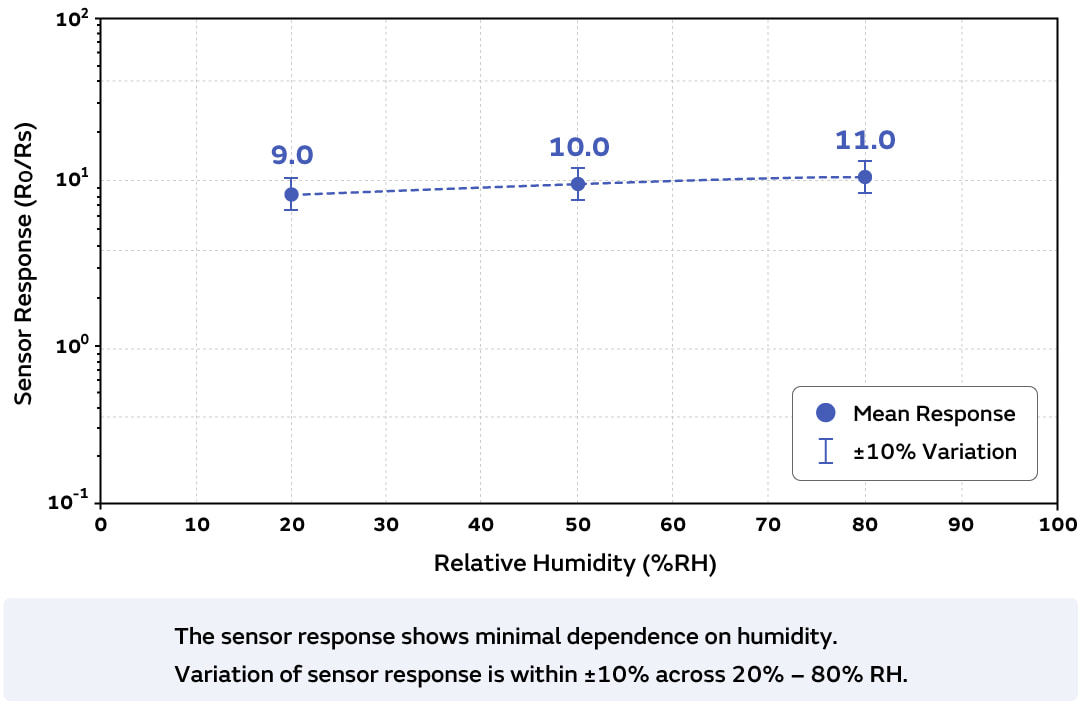
Humidity dependence of the sensor response In this way, outstanding ceramic materials were essential to the development of MOX sensor elements. The ceramic material development know-how cultivated by Murata played a key role in elevating the performance of the olfactory sensor to a practical level.
Fields in which utilization of the Olfactory sensor is anticipated

Field of Application 01 Prevention of problems with machines and equipment in factories
The olfactory sensor can detect and classify faint odors, so it can find abnormalities that may lead to problems in machines and equipment. In particular, and unlike gas sensors, it can handle various odors. This will make it helpful in the analysis of unexpected abnormalities as well. The sensor can also realize real-time monitoring for abnormalities because it can stably and rapidly detect and classify odors.

Field of Application 02 Quality control for food
The olfactory sensor can find abnormalities in food that are hard to identify visually—for example, spoilage or contamination—by odor. Accordingly, it can help prevent risks from materializing on manufacturing lines and in warehouses. Adding odor as a parameter to manage processes in bulk manufacturing environments can help stabilize quality. Furthermore, the AI model is capable of learning the evaluation criteria used by experts, so the sensor can also help improve the accuracy of sensory testing.

Field of Application 03 Maintenance and improvement in the quality of care at nursing facilities
Sensing changes in a resident's condition through odor with the olfactory sensor can improve the quality of nursing care services while preserving privacy. The sensor can also realize the remote monitoring of living quarters. This will make it easier to maintain the quality of services even when staffing is limited.

Field of Application 04 Improvement in the accuracy of online medical care and healthcare
Quantifying the odors of patients with the olfactory sensor will expand the range of information that can be obtained by doctors during online consultations. Furthermore, as the quantification of odors from various human subjects progresses, it will pave the way for the development of online healthcare services.
FAQ
Regular, application-specific gas sensors are designed primarily to detect and measure specific gas components. In contrast, Murata's olfactory sensor aims to detect differences and changes in odors comprised of multiple components by using machine learning to analyze the response patterns of multiple MOX sensors made from different materials.
Odor identification depends on linking the detected complex mixtures of gas molecules with sensory descriptors. We are now building up datasets to expand the range of odors that can be identified. The gas molecules that can currently be detected are as follows: sulfur-based substances such as hydrogen sulfide and methyl mercaptan; nitrogen-based substances such as ammonia and trimethylamine; fatty-acid-based substances such as acetic acid, butyric acid, and isovaleric acid; ketone-based substances such as acetone; and substances with moldy odors such as geosmin and 2-methylisoborneol.
The olfactory sensor is currently in the development stage. We will explore potential applications together with collaboration partners.
Many methods have been proposed for sensor devices that mimic the human sense of smell. However, the olfactory sensor developed by Murata stands out for its ability to detect gas molecules at the ppb level in as little as five seconds. Moreover, we have minimized the impact on the sensor response due to changes in humidity with our materials design.
We believe that the quantification of odors by the olfactory sensor will prove helpful in the automation and objectivization of evaluation and monitoring that previously used the human sense of smell. We are currently collaborating with several partner companies to commercialize the olfactory sensor. However, we are exploring even more specific applications. We welcome inquiries from those interested in working with us on such applications.
Message From the Developers

-
Murata Manufacturing Co., Ltd.
Ryutaro Sato
Advanced Device Technologies Development Department, New Technology Center,
Corporate Technology & Business Development Unit
Takeo Arakawa
Yuki Yonezawa
Chika TahataAlthough most people experience odors in their daily lives, information about this had previously been difficult to handle as data. We are developing technology with the desire to be able to handle these ambiguous and complex odors using sensors and algorithms. At this stage, rather than limiting the technology to specific applications, we would first like to broadly raise awareness about the potential of Murata's odor sensing technology and obtain ideas for possible applications from diverse perspectives. We look forward to receiving inquiries from companies that wish to create new value with a fresh approach to odors.
News
-
We have posted the "Olfactory sensor" development theme for which we are looking for collaboration partners.

Inquiries
Please feel free to contact us if you are interested in Murata's odor sensing technology or potential applications that combine sensors and algorithms.
* This product is under development. Therefore, the specifications are subject to change without prior notice.