

Partner With Us - Current Themes
Able to detect even transparent objects like glass and black objects at distances as short as 1 cm
Thermophone
Recommended for:
- Developers of automated transport robots and compact mobility units who want to enhance safety by short-range detection of objects that optical sensors have difficulty with, such as glass or black plastic pallets
- Companies that need to detect surroundings in environments where optical sensors have difficulties, such as in direct sunlight or dark areas
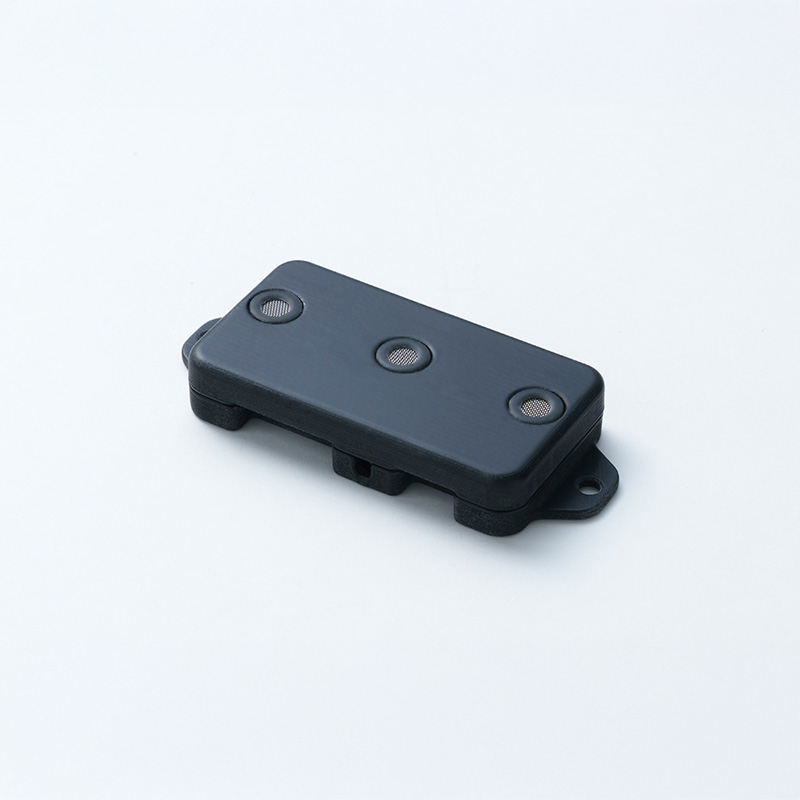
Thermophone module that uses ultrasonic waves to detect the surroundings
Challenges for robotics: Detecting the surroundings
Optical sensors such as LiDAR and cameras are currently the main choice in the development of systems such as autonomous mobile robots and self-following mobility units. However, these sensors are easily affected by light transmission, absorption, and reflection, which makes it a challenge to detect transparent glass and black objects, so the risk of collision remains.
Murata's thermophone leverages our thin-film technology to address this issue, making it a key device for more reliably detecting the surrounding environment. It uses ultrasonic waves to detect the surroundings, making it possible to detect obstacles regardless of color or transparency. Another major advantage is the ability to detect obstacles at distances as short as 1 cm. The addition of Murata's thermophone to existing systems helps to increase reliability and achieve safer robot operation.
The thermophone's ultrasonic wave-generating technology makes it possible to accurately detect the external environment
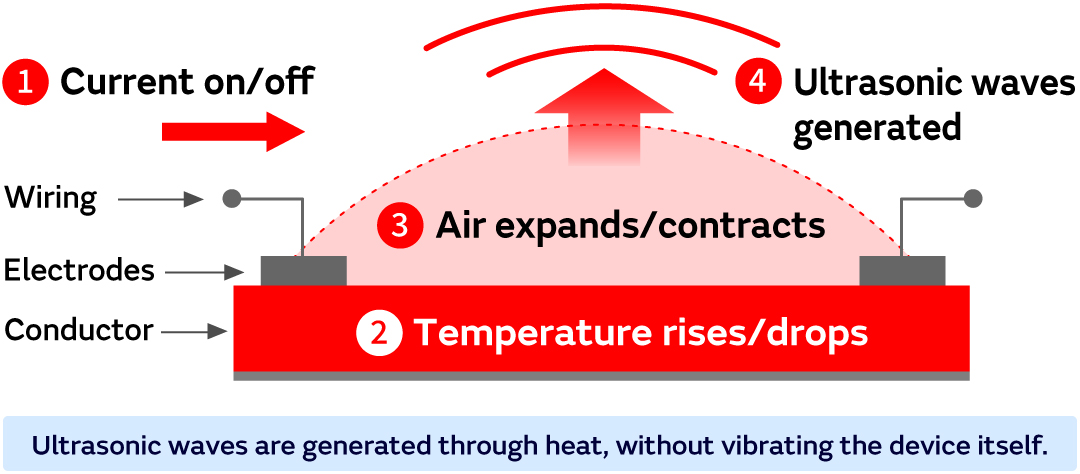
Murata's thermophone instantly converts electrical energy into heat and generates ultrasonic waves by causing the air in contact with the device to expand and contract.
Unlike typical piezoelectric ultrasonic sensors, which generate ultrasonic waves by physically vibrating a piezoelectric element, the thermophone is non-vibrating: the device itself does not vibrate. As a result, it produces no ringing and can generate wideband ultrasonic waves.
Thermophones, which generate sound using thermal expansion and contraction of air in this way, have been known for a long time, but achieving both high sound pressure and reliability has been a challenge. Murata addressed this challenge by optimizing the structural design of the thin-film element and applying the thin-film manufacturing technology we have cultivated over the years.
This technology was recognized with the Semi Grand Prix in the Open Category of the CEATEC AWARD 2020. Since then, we have continued making improvements toward practical application, including enhancing the performance and reliability of the device and further refining the module.
Thermophone module with integrated signal processing functions
Murata's thermophone module integrates a unique thermophone device with two receiving microphones and a Micro Controller Unit (MCU) that performs signal processing. This module alone enables things like:
- Output of peak information for highly accurate 2D detecting of the surrounding environment at distances from as short as 1 cm up to 2 m
- Ultrasonic sensing enables the detection of obstacles that optical sensors have difficulty with, such as transparent and black objects, metal mirror surfaces, and low-profile obstacles such as cords. It is also unaffected by ambient light.
Part of the signal processing is built-in, and information about the strength and timing of echo peaks from obstacles is output. This means that, by having a higher-level system calculate the coordinates, the 2D coordinates of obstacles can be output.
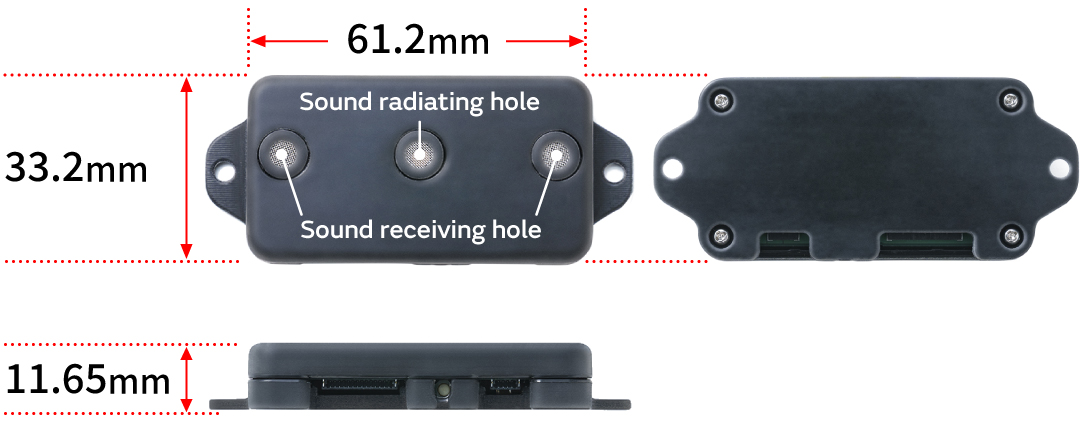
Achieving Short-Range Detection Down to 1 cm and High-Precision Positioning
Use of a wideband chirp signal and signal processing to accurately distinguish closely spaced objects
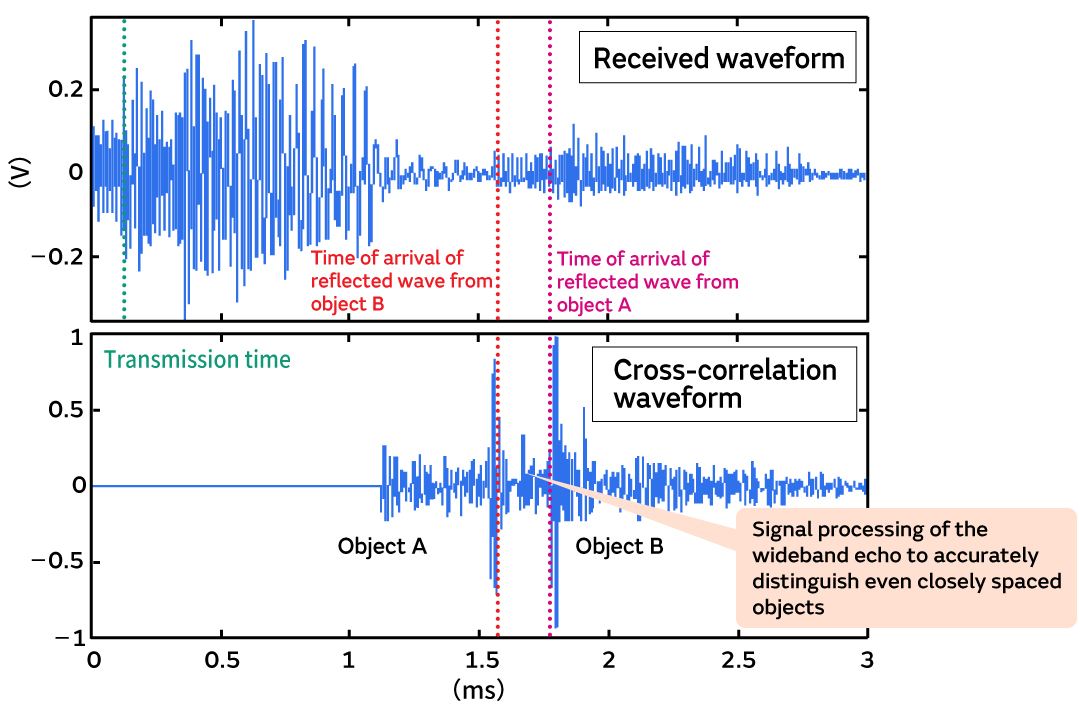
In a piezoelectric ultrasonic sensor, the device itself vibrates, which means that ringing can interfere with detection at close distances.
In contrast, a non-vibrating sensor like a thermophone does not produce ringing, making it possible to output a wideband chirp signal. Performing cross-correlation processing on the received signal makes it easier to capture the timing of the reflected waves as sharp peaks and also provides a high S/N ratio.
This enables detection at distances as short as 1 cm, as well as high-precision 2D sensing and the ability to distinguish closely spaced objects with high accuracy. It can also reduce the impact of environmental noise and interference from other robots, helping robots reliably sense their surroundings.
Fields where thermophone use is expected
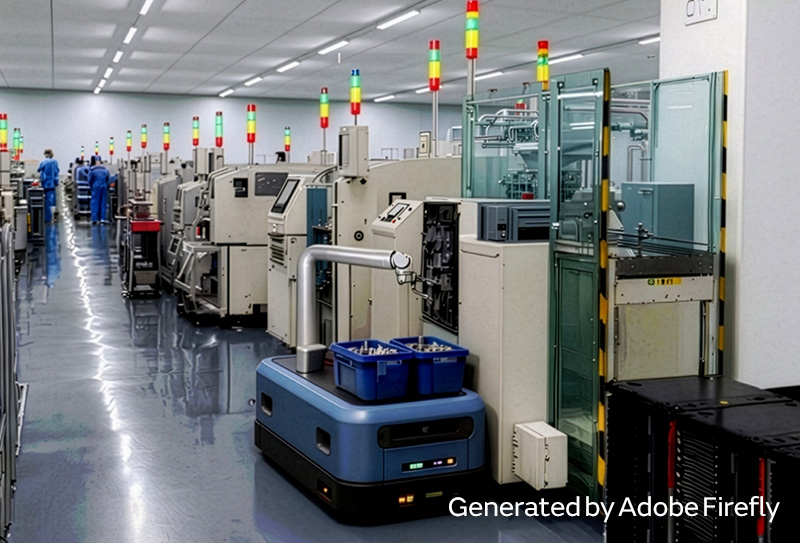
Field of Application 01 Transport robots in factories, etc.
The ability to detect obstacles at distances as short as 1 cm makes it possible to precisely approach equipment and machinery. It also enables the detection of obstacles at foot level such as forklift forks, which optical sensors tend to miss.
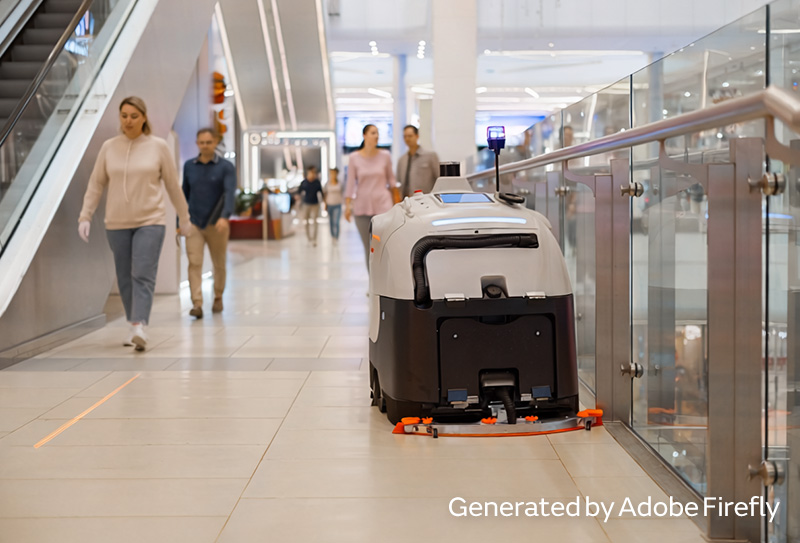
Field of Application 02 Commercial cleaning robots
Close-proximity travel along walls made of transparent materials or mirror-finished metal surfaces, which optical sensors have difficulty detecting, is possible. The thermophone can also detect low-profile objects such as cords, items placed in the travel path, and people moving around nearby. Furthermore, it helps reliably sense the surroundings in various operating environments, including locations with strong ambient light such as glare from the setting sun and in dark areas.
FAQ
The biggest difference is that the thermophone is non-vibrating. Instead of physically vibrating the device itself, it uses the thermal expansion and contraction of air to produce clean ultrasonic waves without ringing. Short-range detection had been considered difficult for piezoelectric ultrasonic sensors, but our thermophone module achieves detection at distances as short as 1 cm.
It has higher resistance to noise than typical ultrasonic sensors, but the detection range may become shorter in extremely noisy environments.
10 fps.
A module that outputs peak information is available. It is assumed that customers will handle integration into their system themselves.
Message From the Developers

-
Murata Manufacturing Co., Ltd.
Masayoshi Takagi
Applied Technology Development Dept. Device Center Corporate Technology & Business Development Unit
Shun SakamotoInorganic Materials Development Dept. Materials Technology Center Corporate Technology & Business Development Unit
Kohei FukamachiMurata's thermophone is a device that generates ultrasonic waves through instantaneous heat changes and is capable of short-range detection at distances as short as 1 cm. We believe that adding an acoustic sensor to existing systems can help achieve more robust sensing of the surrounding environment. We are continuing to refine the technology to make it even easier to integrate into your systems and genuinely easy to use in real-world environments. We are also proceeding with verification of the thermophone module to support the smooth and stable operation of various autonomous mobile robots, including AGVs and AMRs.
We aim to contribute a future where autonomous mobile robots can operate more safely and be widely accepted by society, and would love to hear about the challenges you are facing in your workplace. We hope to work together with you to evaluate the thermophone in actual usage environments and explore how to combine it with your systems. By combining your challenges with our technology, we hope to create new possibilities together. Please feel free to contact us.
News
-
We have posted the "thermophone" development theme for which we are looking for collaboration partners.

Inquiries
Please feel free to contact us if you are interested in our thermophone that can detect even transparent objects such as glass and dark objects at distances as short as 1 cm or want to learn more about this technology.
*The thermophone module is currently under development. Therefore, the specifications are subject to change without prior notice.